navigation

Wednesday, February 11, 2015

The Mystery of the Red Coat

A year and a half ago, I thought I had found the first instance of Captain Hook in a red coat--illustrations by American Roy Best from 1931. Before then, Hook was depicted in coats of blue and gray. Of course, since the 1957 Disney film (which went into development in 1935), he's generally depicted wearing red.

But now I've learned that British painter Gwynedd M. Hudson had the same idea as Best at around the same time. As Hudson is one of my favorite Peter Pan illustrators, I'm glad now that I decided Jas. should have not only his original blue and gray coats, but red. (Although in The Stowaway, they are reserved for battle and other important occasions.)


 James, splendid in his red coat.


I'm amused how well my characterizations of the crew align with Hudson's.

My visit to the Marchpane children's bookshop at Charing Cross in London turned out to be edifying in this regard. Not only did I get to hold a 1904 first edition Peter and Wendy (with appropriate whimpers and hopes of "someday"), the seller also had a 1931 Hudson first edition with dust jacket (those don't usually survive) which now lives at my house. That was a fantastic surprise.


I have several versions of Peter Pan that include Hudson's illustrations, reprinted in a single color. I knew from pictures I'd seen online that some of the originals were in two or three colors--but in the first edition Hudson, there are many full-color illustrations as well.


It turns out to be almost impossible to find information about Hudson online. However, Antiques Atlas has a profile that gives me far more information than I've been able to find before:

Gwynedd May Hudson, 1882-1932, was a Sussex artist, who studied at Brighton College of Art. She exhibited a painting at the Royal Academy in 1912, but is best know for her much loved illustrations of Alice in Wonderland in 1922 for Hodder & Stoughton and Peter Pan and Wendy in 1931, also for Hodder and Stoughton.

She also did a series of posters for the London Underground 1926-1929, copies of which are in the London Transport Museum. One of these lithographic posters of 'The Zoo' for the Underground achieved a price of £2,750 at Christie's in 2012.


Most sources give Hudson's date of birth as 1909. She might have been a prodigy who published Alice in Wonderland illustrations when she was thirteen,but it's unlikely she exhibited at the Royal Academy at the age of three. I'm also glad to know she didn't die at the age of 33.


Hudson seems to be best known for her Alice paintings.These are easily found reproduced online and for sale from auction houses, and even on mugs and t-shirts.

Friday, January 23, 2015

A partnership

A bit of back story that doesn't have a place in The Stowaway, but has found one here in Hook's Waltz.


She wasn't afraid of him, though perhaps she should have been. Of course it was her own establishment, and not as if the Scarlet Slipper relied upon the custom of him or his men—although certainly young Dorothy would have protested the loss of Mr. Mullins.

He had certain predilections which were not to her taste, to be sure, and she understood why the girls found him forbidding. But he was cleverer than most of her clientele, and more stylish, and his manner of speaking brought a bit of class to her drawing room. The drawing room where she met him now, where he refused to take a seat beside her, instead standing by the window out of the circle of light cast by the tasseled lamp overhead.

“I suppose this is when you tell me I am no longer welcome in your establishment.” He drew the curtain aside to peer out the window into the rain-swept Dover street and did not turn to meet 'Becca's eyes.

Dover, Inner Harbour, after John Henderson I.
 J.M.W. Turner, c. 1794-7, Tate UK

"You sound as though you are familiar with the request. But no, Captain, that is not why I asked to speak to you. Although I expect you know—”

“That my demeanor unsettles the ladies,” he said, throwing himself down upon the settee with such force that the teacup and saucer on the adjoining table did a merry dance. “They have not made it much of a secret.”

Good, thought 'Becca. She didn't want her girls to feel they couldn't speak up, couldn't defend themselves if they found it necessary. She had made her living and her reputation from a coterie of women who were genuinely willing to ply their trade, not to mention the pride her customers could take in being worthy of their attentions. If the Slipper lost a client from time to time, the loss was scarcely noted. And the loyalty her girls felt towards her, and the camaraderie among them, were qualities she had been told not to expect and which she was now most proud to have cultivated.

“Captain,” she said, interrupting the rapid tapping he made upon the arm of the settee with the point of his hook. “Please, do think of the furniture.”

“James,” he said. “If we are familiar enough to have such a conversation, you can speak to me by name.”

“James it is, then. And I am 'Becca.”

“'Becca,” he said, with the first inclination toward a smile she had seen upon his face. How strange that at times he seemed to have both the manners of a gentleman and the humbleness of a chastened boy.

“So, James, I have another proposition for you, should you care to hear it.”

“If courtesy alone did not do so, curiosity would persuade me to ask.”

Withdrawing a leather-bound notebook from beneath the cushion at her elbow, she handed it to the Captain, and dove into the waters of hope.

“'Tis the trade I had hoped to embark upon originally,” she said as he thumbed through the book, speaking quickly so she would not be distracted by the looks he cast upon the pages. “But making a living as a dressmaker was not as easy as I had hoped, not if I wanted to do more than patch the elbows of shirts and darn the heels of socks.”

He rose and carried the book with him to the window, pulling aside the draperies again to allow light to fall upon the drawings. “These are your designs?”

“Every one.”

“Have you sewn any of them yourself, or are these the drawings from which someone else will work?”

“I have sewn every scrap upon my person, and upon my girls as well.”

His eyes scanned the mauve silk of her gown, from the finely-stitched collar to the pintucked bodice to the rows of lace which adorned the skirt. “Most impressive. I had no idea.”


Later 'Becca would examine the fine gold of his compliment, but now was no time for such indulgence. “Look to the end of the book, if you would.”

The Captain complied, and a true smile grew upon his face as he did so.

“Coats worthy of a pirate captain,” said 'Becca, her confidence swelling. “And swatches of fabric on the back cover, if you would care to examine them as well.”

“This scarlet, it is quite magnificent. And the blue...”

“I thought 'twould bring out your eyes.” Perhaps she should not have said such a thing, that she had noticed that this fierce and notorious man, with his outrageous hair and remarkable height, the terrible steel hook in place of his right hand, had eyes the exact shade of forget-me-nots.

“Do you think so?” said James, pursing his narrow lips. “Perhaps it would do me no harm to dress to my natural inclinations, and Mr. Smee would be happy enough to forgo the responsibility of outfitting the crew.” He returned his attention to the notebook. “Gentleman Starkey, surely, would have need of this trade as well as your other. And Mr. Cecco would welcome the chance to strut his finery upon my deck. Although I should warn you, he is inclined towards removing the sleeves from his shirts. Perhaps waistcoats would better suit our Mr. Cecco.”

'Becca could not keep the grin from her face. “Have we a bargain, then, James Hook?”

“We do indeed, 'Becca Bloom, and I shall make your efforts worthwhile,” said the Captain, holding out his left hand. She took it in her own, a handshake to conclude a business transaction the likes of which she had never dreamed about in her tiny Yorkshire bedroom years before.

“Tea, Captain?”

“Yes, indeed. Let us drink to a partnership that I hope will transcend the years.”

'Becca poured a cup for the Captain and another for herself. “And James? You are content to leave our business as such?”

“'Tis rare enough that I may count someone a friend, 'Becca Bloom. If this means I may reckon you one, I will be well content to follow the rules as you make them.”

“Then a friend you shall have, James Hook. And a friend you shall be."

His face grew gentle, then, and his eyes warmed. She would not have guessed at such a tenderness the day he first appeared at her door, leading a half dozen of his men, all wet to the skin from rain and demanding entry. For not the first time, she was pleased that she had allowed them in.


Friday, January 9, 2015

Peter at the hospital

There is no more fitting place for a Peter Pan purist to visit than London's Great Ormond Street Hospital.

The hospital has had a long association with The Boy Who Wouldn't Grow Up. In 1929, J.M. Barrie declined to sit on a fundraising committee to help it expand into the vacated Foundling Hospital adjacent--and instead donated the royalties from stage performances of Peter Pan to GOSH, funds which they receive to this day. (For more information about the copyright extension in the UK and Europe that allows the hospital the continuing right to royalty, see the GOSH website. There you'll also find additional history--and better pictures than I have here, but that can't be helped.)


"At one time Peter Pan was an invalid at the Hospital for Sick Children," Barrie said in a GOSH fundraising speech in 1930, "and it was he who put me up to the little thing I did for the hospital."

At one time, the hospital maintained a museum of Peter Pan books and memorabilia. While that museum has fallen victim to the hospital and charity's need for additional space, the collection is still available for public viewing by appointment. Of course, I could hardly visit London and not at least attempt to see the collection. 


The hospital was officially named
Great Ormond Street Hospital for Children in the 1990s,
 as it had become so closely associated with the street.

When I made my appointment, I wasn't certain if I should admit to my involvement with The Stowaway and especially this blog. But I knew I wouldn't be able to keep that to myself and didn't want to spring it upon the staff, so I gathered my courage and confessed via email. And because I did, I was able to have a splendid visit with people who understand my devotion to Mr. Barrie's tale.


The collection being kept in this room was pure
coincidence, I'm sure, but a most fortuitous one.


Christine De Poortere, Peter Pan Director, and Emily Beahan kindly allowed me to babble about my own collection and thoughts about Peter and the Captain, and let me photograph the figurines, plates, magic lantern slides, and other memorabilia that have been given to the hospital over the years. These include the bell that was Tinker Bell's voice in the original 1904 stage production of Peter Pan. And yes, I got to ring it.


The bell in the back right corner was
 used to voice the original Tinker Bell.


GOSH has more Peter Pan books than I do--
two cupboards worth.

Casts of London productions of the play still put on performances at the hospital for patients, as they have done for decades. And Peter's influence is felt throughout the halls.

Art students of the University of Wolverhampton
 created and donated this tiled mural in the late 1980s.

Peter appears where he is not expected, as is his wont.

Since it opened its doors on Valentine's Day of 1852 as the Hospital for Sick Children, GOSH has grown tremendously, expanding into many surrounding buildings in its neighborhood of Bloomsbury, where Barrie lived for a time just around the corner from the original hospital. It's part of the National Health Service, but funds raised from donations help them with redevelopment, research, medical equipment, and support services for families.

The charity staff at GOSH couldn't have been more gracious, and I'm certainly glad I was able to meet them and take the tour. Of course I'm also pleased to know they are still receiving the benefit of Barrie's donation, and putting it to the best of uses.

Thursday, December 11, 2014

Peter sings, but not always

NBC's Dec. 4, 2014, Peter Pan Live was the second in the network's present-day lineup of holiday live musical performances (the first being last year's Sound of Music)--but it's the third time the network has presented a live musical version of Peter Pan.

Tracking the musical changes in J.M. Barrie's play is as challenging as following Peter himself through the treetops of Never Neverland. Not only did the playwright himself make changes to his work for more than twenty years, only publishing its final form in 1928, some of the songs we most associate with the play came years after that. And it seems nearly every time it's staged in the U.S. for Broadway or TV, it appears with new music.
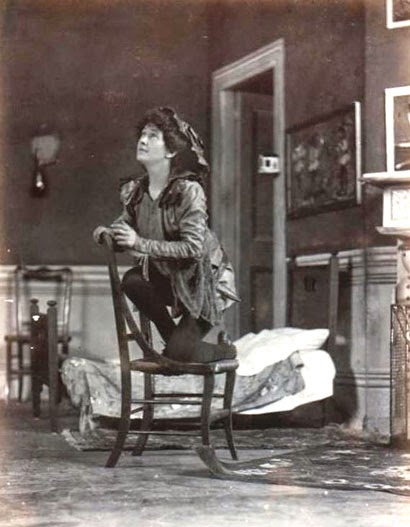

Nina Boucicault


Peter Pan premiered at the Duke of York's Theatre on December 27, 1904, with Nina Boucicault in the title role. Thus began the tradition of casting a woman as Peter. Barrie was never averse to the idea of a boy in the role, but child labor laws of the time prevented children from working in the theater at night, and women were considered more believable as boys than were grown men.

Producer Charles Frohman brought Peter Pan to America in 1905 with Maude Adams in the title role. Bookmice has some fun facts about the production, including the fact that Barrie was skeptical that the play would find success in the States--until it ran for ten years. Adams was a singer, and her Peter sings the bawdy "Sally in Our Alley" to the lost boys. And it was she who introduced the world to both the Peter Pan collar and Peter's feathered cap. Frohman often added music by new American songwriters to plays he brought from England, and in 1907 Jerome Kern and Paul West included a ditty called "Won't You Have a Little Feather" to a pillow dance scene with the lost boys.


Maude Adams


The original play featured a couple of songs--"Lullaby" and "Song of the Pirates"--and a score by John Crook (composer and conductor for Duke of York's Theatre), but it wasn't until the 1950s that Peter Pan became a full musical. Leonard Bernstein wrote music for a show produced by Peter Lawrence for the 1949-1950 Broadway season, which was scaled down to "a fantasy with music," because the actress playing Peter, Jean Arthur, didn't sing. Six songs remained, three for Wendy, two for Hook (Boris Karloff) and his pirates, and one for a mermaid duo.

Barrie biographer Roger Lancelyn Green was not impressed with the changes:
By this time the craze for musicals had fallen like a blight upon the American stage, and therefore Peter Pan  must be shorn of Crook's music; Leonard Bernstein must write a new score and interpolate five songs, while a ballet sequence must be devised for the Redskins, and the pirates become a chorus.

Nevertheless, Bernstein's Peter Pan was a hit with audiences and most critics--and was then overshadowed altogether by the Disney animated film in 1953. Bobby Driscoll played Peter, and an entirely new set of songs were written by Sammy Cahn and Sammy Fain. "What Makes the Red Man Red?" is one of the more awkward relics of its time, and is frequently replaced in current stagings like NBC's Peter Pan Live. "You Can Fly, You Can Fly, You Can Fly" and "Your Mother and Mine" are more fondly remembered.


Mary Martin and Cyril Ritchard


Mary Martin became Peter in 1954 with another Broadway staging, this one with new songs yet again. Forty-five minutes of music were added, which necessitated cutting the script itself. and Jerome Robbins came on board as director, while Johnny Richards wrote music and Carolyn Leigh lyrics for "I've Gotta Crow," "I'm Flying," and "I Won't Grow Up." But the production didn't initially fall together in a way that pleased anyone, and Jule Styne, Adolph Green, and Betty Comden were brought in to add tunes, including  "Never Never Land" and "Hook's Waltz" (and yes, that is the origin of this blog's name). Unfortunately, there was again a song, "Ugg-a-Wugg," which makes modern audiences cringe. New York Times critic Brooks Atkinson wrote that the score "has no audible fondness for Barrie," but this is the version of Peter Pan most often performed now in the U.S.


Danny Kaye and Mia Farrow


And the other two NBC productions? The first was the Mary Martin staging, still beloved today, which was broadcast live on NBC on March 7, 1955 and reprised in 1956 and 1960. And in 1976, NBC produced another version of the play as a Hallmark Hall of Fame presentation, with Mia Farrow as Peter and Danny Kaye as Hook. Another new score was written, with a few strong numbers, but the overall effect was considered lackluster and the show was not broadcast again.


A Peter Pan remembered fondly by both television and theater audiences is Cathy Rigby, who took on the role from 1990 to 2013 (with more than one farewell tour, so don't count her out yet). Her performance was broadcast by A&E in 2000, and she receiving a Distinguished Lifetime Service Award from The League of American Theatres & Producers in 2004.

And the changes continue. While Peter Pan has been adapted in the 2000s in UK as panto, which doesn't stretch it too far out of its original form, new music has also been written for other UK renditions. In 2001, Peter Pan, a Musical Adventure was performed as in the UK as a concert and then made into a stage production in 2007.


I could never have followed the trail of Peter Pan stage interpretations without Bruce K. Hanson's Peter Pan on Stage and Screen 1904-2010 for much of the information in this post. Here's his blog and review of NBC's 2014 Peter Pan Live.


Thursday, December 4, 2014

In the wake of NBC's Peter Pan Live

Reading the live Tweets of Peter Pan Live has reminded me how many people haven't read J.M. Barrie's original Peter Pan. It's also made me want to climb on a plinth and begin expounding upon the themes and characters I've been researching for three years as I write The Stowaway. Instead, I offer this highlights reel of "Hook's Waltz." (Fear not, a new post with original content is in the works.)

F.D. Bedford, 1904


Tuesday, November 11, 2014

Further travels (some of relevance to the book)


While my husband and I didn't make our trip to the Tower of London only to see the Blood Swept Lands and Seas of Red installation by Paul Cummins and Tom Piper, it would have been worthwhile to do so. We missed a visit to the exhibit by the Queen that day, which is likely for the best as no doubt we would have seen mostly crowds and not much art.

Each of the 888,246 red ceramic poppies commemorates the death of a British soldier in World War I, and the final poppy was placed on Armistice Day, November 11. Originally scheduled to be taken down on November 12, the poppies will be left in place for an additional week before parts of the exhibit are taken on tour around England.


More information can be found at the British Legion website, and Huffington Post has some lovely photos of the poppies at twilight.


View from the Serpentine Bridge, facing east
into Hyde Park

While I wasn't able to spend quite enough time in London and Bristol to see everything I'd hoped to visit for research purposes--perhaps that was an impossible goal--I certainly made the most of the hours I had.

The Stowaway takes place in 1908, but the famous statue of Peter Pan in Kensington Gardens wasn't erected till 1912, Given the likely reaction of the Captain to its presence, this is probably just as well. But I could hardly visit London without seeing it for myself, could I? The Captain and Vivian do walk through the park and over the Serpentine Bridge as they make their own way through London, so that landmark did qualify as research.


A rare photo of the writer in the wild.

A current modern touch is a plaque with a QR code which a visitor can scan with a smartphone to hear "Peter" talk. While he sounds suspiciously adult, he is every bit as cocky as his literary counterpart.


Peter is of course the star attraction, but fairies and rabbits cluster about the base of the statue, and they deserve attention as well.


Vivian and James have less time to visit the landmarks of London than did I, but their travels do take them past Westminster Abbey and past the Houses of Parliament. Also a certain large clock there is familiar to anyone who has ever seen a movie or illustrated book of Peter Pan.


St. Katharine Docks, where the Jolly Roger moors during its time in London, are just beyond Tower Bridge and to the left.

From London we traveled to Bristol. While there are no direct Peter Pan associations to be found in Bristol, the city was the inspiration for the beginning of Treasure Island, which was an influence on J.M. Barrie's book. Also, Wendy Darling was given her first name by Margaret Henley, the daughter of William Ernest Henley--Robert Louis Stephenson's inspiration for the character of Long John Silver, though by all accounts a far more upstanding citizen.


The Llandoger Trow pub is said to have been the inspiration for the Admiral Benbow tavern in Treasure Island.


Bristol Castle has no connection at all to Peter Pan, but it is a beautiful piece of architecture near the city's Floating Harbour on the River Avon.


This weathervane in Bristol does, at least, have a maritime connection.

Friday, October 24, 2014

Following my characters through London


This blog has been on a brief hiatus while my husband and I visited the cities of London and Bristol for our fifteenth wedding anniversary. Of course, this was also a significant Research Opportunity, and I felt it necessary to follow as best I could in the footsteps of Jas. Hook as he shows Vivian Drew the sights of London. From the approach through Tower Bridge (though we saw it from a river tour boat, rather than arriving from the other direction aboard a tall ship) we went,


to the Savoy Hotel on the Strand in Central London, overlooking the Embankment and the Thames River, tracing the path of the characters in The Stowaway.


The Savoy is celebrating its 125th anniversary this year, and was refurbished earlier this century to include both art deco and Edwardian style. The main dining room, where Vivian and James dine, is now Kaspar's, which serves fantastic seafood. The restaurant also continues to serve its traditional pĂȘche Melba, peaches with vanilla ice cream and raspberry sauce. Rather than being served with a sculpted-ice swan, as it was when it was created in 1892, today's version includes a "white chocolate sphere," which melts when topped with the warm sauce.


The redecorated room includes a new "winter garden gazebo," but is still recognizable as the venue for this 1907 New Year's Eve celebration.


James's family keeps a townhouse in Mayfair (much to Vivian's disappointment, as she expected a grand house on a large property). Mayfair is now under a great deal of construction, and many of its homes are now owned by absentee billionaires from other countries.


The National Gallery, however, is much the same, down to the paintings by J.M.W. Turner,


and so is the quick walk along wide, pale paving stones to the nearby Haymarket Theatre Royal. Noted actress Lillie Langtry was appearing in a scandalous comedy called A Fearful Joy in 1908, whereas we saw a production of Great Britain, a satire of tabloid culture and the Rupert Murdoch newspaper phone-tapping scandal. 


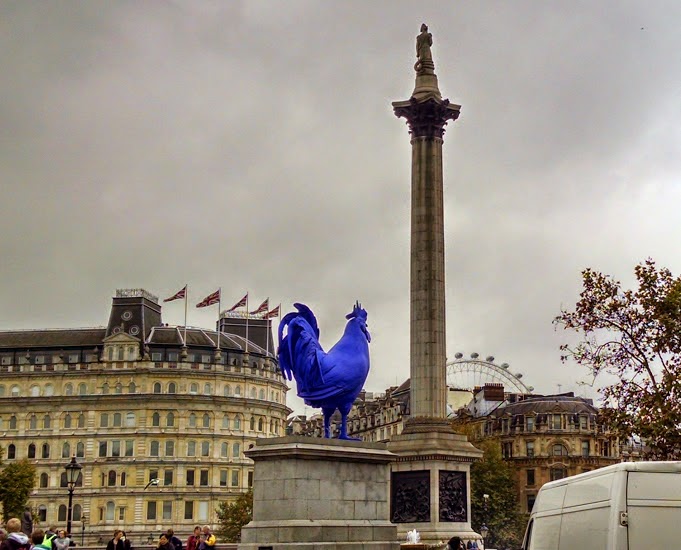
One of the advantages of writing about a city so rich in history is the knowledge that so many of the places my characters visit are the same, or nearly the same, now. I could easily summon Vivian's delight in the landmarks she had never expected to visit Of course there was no Millenium Wheel in 1908, or--I suspect--a blue rooster on a plinth in Trafalgar Square.