navigation

Monday, June 27, 2016

Progress report

I'm interrupting the usual focus of this blog for a progress report. Hook's Waltz is, after all, a blog in the service of a book, a book which has been long in its creation, and it seems appropriate to take note of its evolution as I move into (what I hope is) the final stretch.

It's an entire book now, albeit one which is not in its final form. I squeezed fifty-odd pages of notes into fifteen, at least of half of which I hope to find a place for in the final draft. (As bad as that sounds, the original "notes" document was a staggering 115 pages.) And there still a couple of spots with blue lettering--so I can't miss it--saying things like "Insert accurate nautical terminology here!" The historical aspects of The Stowaway mean that I can never learn too much.


I'm reading the manuscript out loud (to the delight or chagrin, I'm not sure which) of the feral foster cat who is my audience. I've read that writing fiction on a computer short-circuits some of the processes that handwriting facilitates. I don't know the truth of that, but I do know that repetitive stress injuries and bad handwriting (I blame grad school, because it was fine before that) mean that I will never write a book long-hand. But reading aloud seems like it may accomplish some of the same aims.

It's my preferred method of finding words I overuse (ahem), sentences that don't flow, bits that don't fit with other bits. This method is harder and creates more work than the other revisions I've done, and I can't say it's my favorite part of writing. I do, however, appreciate the results.


Before I can call The Stowaway a finished work, I want to make sure I have enough understanding celestial navigation to be able to write Vivian Drew's experience of learning it. Trigonometry was the only math class I ever enjoyed, but that was long enough ago that its tenets are no longer at my ready retrieval. I've learned how to read a sextant, but there's far more to the art and science of navigation than that.


I am also immersing myself in relevant works so that I'm living the narrative as much as I can while I complete the manuscript.


I will also make time for DVD watching, so images of faraway places are clear in my mind. (Maybe Robert Newton's Long John Silver isn't so good for research. But it was a lucky thrift-store find, and does fit with the general immersion theme.)

My beta readers are ready. I have a background in non-profit grant-writing that I plan to turn towards synopsis and query letters.


And then I run up the sail and strike out for distant shores.


Friday, May 20, 2016

The artist who dressed the pirates

You may not know the name of its artist, but there's a good chance you know this painting:


Captain Keitt, 1907, by Howard Pyle

It's one of the more popular pieces of pirate art in circulation. And if you've seen a Pirates of the Caribbean movie, you know that the influence of the artist, Howard Pyle, continues today. Historical records speak of pirates wearing finery stolen from aristocratic captives, but it was Pyle who turned the notion into the raffish fashions we still associate with the trade.


Painted 1910, the year before Pyle's death


The Mermaid is another one of Pyle's familiar works. I'm pretty sure I still have my poster of this somewhere (continuing my habit of being unrelentingly drawn to art and objects from the Edwardian era). You can find this image printed on t-shirts and mugs and magnets and any number of other items.


"The Buccaneer was a Picturesque Fellow"
1905
(Yes, indeed he was.)

While in a collectible-book store in Port Townsend, Washington, recently, I found a copy of Pyle's Tales of Pirates and Buccaneers, a slimmed down 1994 children's edition of the original Howard Pyle's Book of Pirates: Fiction, Fact & Fancy Concerning the Buccaneer. Not long after, a thrift store yielded a 1954 reprint of his version of The Merry Adventures of Robin Hood, complete with colored illustrations. I took this as a hint to do a bit of research on this man who created what we think of as piratic style today.


Pyle, who was born in Wilmington, Delaware, in 1853, became well-known not only for his magazine and book illustrations, but for retellings of the legends of such classic characters as King Arthur and Robin Hood. He founded a free school of art in Wilmington, where many of his students, including Maxfield Parrish and N.C. Wyeth, went on to significant success as members of what is now known as the Brandywine School. Notably, 40 of his 110 students were women, including his sister Katharine Pyle, who became a popular illustrator of fairy tales.

His talents even extended to costuming, and he designed the costumes for the Broadway production "Springtime" in 1909. (Further proof of Pyle's continued relevance is shown by his presence in that blog and others.) On November 9, 1911, he died of illness in Florence, Italy, where he had traveled to further his own study of art. He left "The Mermaid" unfinished on his easel--so the painting we have today isn't necessarily the final vision he had planned for the work.


"Who are we that Heaven should make
of the old sea a fowling net?"
1909

This one was new to me and I find it particularly evocative. I see a bit of Jas. Hook and Vivian Drew in it, even if it's not set in the Edwardian era of The Stowaway, or about pirates at all. Rather, it's an illustration for The Second Chance by James Branch Cabell, published in Harper's Monthly Magazine in Oct. 1909. It features a Lord Pevensey and a Lady Ormerod, a name which caught my attention as Jan Ormerod is one of my favorite Peter Pan illustrators. We come full circle again.

Monday, April 25, 2016

Good news for collectors (sometimes)

Something I've found while researching The Stowaway is a vast and (to me, at least) surprising discrepancy in the prices of out-of-print books. Some academic volumes from the ancient days of the 1980s are so expensive I can't justify buying one for a single essay on Peter Pan. But in a much happier turn of events, books from the turn of the 19th century are often ridiculously affordable. They're sold as "used," not quite antiques, not quite archivable. And while they're not as cheap as a used Grisham novel, they're also not the price you might expect for tangible bits of history.

I continue to take advantage of the situation.


The most expensive of the books above, Volume I of The Novels, Tales and Sketches of J. M. Barrie, was $10. The others were half that or less. (Ironically, I can't read them now because I have begun channel Barrie's writing style with almost no provocation, and it begins to seep into The Stowaway, where it doesn't belong.)

 I can only conclude these books have fallen into "the Trough of No Value." Mike Johnston of The Online Photographerr has this graph in his essay on the subject:


Johnston's examples include photographic negatives, computers, and lunchboxes from the 1950s and 1960s. "One of the problems of historical preservation is that people only tend to preserve things that are valuable," he writes. "And the problem with that is that value fluctuates over time." This, of course, is difficult to predict.

He also mentions that the craftsmanship of an item can determine its fall into the Trough. And this applies to books as well, of course. A perfectly-preserved first edition of a still-popular book may cost hundreds or thousands of dollars--why I don't yet have my own first edition of Peter and Wendy. But if someone like me wants a book mainly for its contents, it's worth keeping track of the Trough.

Luckily for my own collecting, I often appreciate a book all the more if it shows signs of its lifespan and evidence that it was loved. A "Merry Christmas" message from Aunt Lizzie, 1909, has value to me which it might not to a regular book collector. (This is the same impulse that has prevented me from refinishing the table I used as the background for these book photographs. A practical nostalgia?)


If you're willing to overlook some damage and signs of age, you can find a treasure trove of books from the Edwardian era. They may be offered by some unexpected sources, and that's part of the fun. I paid under $20.00 for most of these, some of which I discovered in used or antique book stores, others which I found on eBay or from ABE Books.  If they were first editions, or in better condition, they would of course be priced higher, although I think most of them would still qualify as "affordable." But I find value in their shabbiness, in evidence they were read and maybe even loved.


My copy of the 1907 The Girl's Own Annual 

So if you're interested in books of a hundred years ago, this is a good time to buy them. There's no guarantee they'll go up in price, of course, and we can't predict the desires and contexts of future societies. But from what I've observed, and from what the Trough of No Value tells us, these affordable books aren't likely to stay that way forever.


"I must go down to the sea again"


Not  Peter Pan, but relevant to The Stowaway

These books come to us without commentary, giving us a direct look into history without the overlay of our present priorities. And of course reading books from another era is one of the best ways to learn the diction and styles of writing from the past--very useful when writing about those times. But that's a subject for another day.

Wednesday, March 30, 2016

The haunting of Kensington Gardens

There are places in this world that seem to exist as much in fiction as they do in reality: Times Square, Hawaii, Paris. Kensington Gardens in London is another such place, providing inspiration for J. M. Barrie and other writers, and sparking a world entire for Argentinian author Rodrigo Fresán.

I circled Kensington Gardens for a while before I dared open it. Given that it's about a children's book author who kidnaps the young actor who has been hired to play his character Jim Yang, I feared it might not be friendly to my own possibly-romanticized views of Barrie and my Beatles-obsessed early adolescence. The chance of horrific violence tainting either or both also felt like a real possibility. Happily, what I found between its covers was completely different--and far stranger.


Map by Arthur Rackham for the 1906 first edition
of Barrie's The Little White Bird


Kensington Gardens, translated beautifully by Natasha Wimmer, has been described by more than one reviewer as surreal. The narrative wanders through time, a dizzying weaving of facts and images, filled with musings on creativity, death, childhood, and cultural change. The son of a socialite and a rock musician, brother of a boy who died in childhood, Peter Hook (no relation to the Joy Division/New Order bassist) sees ghosts everywhere--whether literary or actual--in his own life, in Barrie's, in the lives of the Llewellyn-Davis boys who inspired the stories of Peter Pan.

Hook is obsessed with Peter Pan and even more so with his author. "Barrie, who suffered so much for us, who died for our sins, and whose only and unpardonable crime was having written an infectious creature carrying an incurable disease," he says. He is determined to find parallels between Barrie's and his own, even when this means ascribing motivations and feelings to Barrie that may have no basis in reality. Given that the even the narrator admits he is unhinged and self-destructive, perhaps we shouldn't take his musings too seriously. Fresán suggests as much in his afterword. But Barrie and Hook are both indelibly marked by the deaths of their brothers when they are children, and perhaps the same ghosts do haunt them both.


Kensington Gardens is thoroughly researched, and I learned a few new facts about Barrie. He was ambidextrous, for one. And as I suspected, like many writers, he was changed forever by World War I and the loved ones he lost to the conflict.

From Fresán's book, I also learned about poet Humbert Wolfe. A popular British writer of the 1920s, he's not well-known now, but I've seen his poem "Autumn (Resignation") on more than one Tumblr post. A version of Kensington Gardens also existed vividly in Wolfe's imagination, and he wrote an entire book on the park in a style not unlike that of e. e. cummings, including--of course--a piece on its famous statue of Peter Pan.


Humbert Wolfe, as drawn by his friend
William Rothenstein in 1931


PETER PAN

Peter Pan
leave your dead
tunes, you faun
of gingerbread !

Over hills
you never guessed
,lonelier
than Everest,

blows an older
colder reed
the belovèd
children heed,

following
(O icy-thin !)
Pan, who was Piper
at Hamelin.


From my own visit, October 2014


Peter Pan as the Pied  Piper is not the most unreasonable comparison. More likely, perhaps, than the duality between Jim Yang and Peter Pan, despite what Peter Hook may believe.

Monday, February 29, 2016

Peter goes to France

Occasionally I search eBay for unfamiliar versions of Peter Pan books and art. I love finding international children's versions of the story--it's always interesting to see the variations in both text and visuals--and this French version did not disappoint.


The illustrations led me to think this translation must be very different from Barrie's story. Note that Tinker Bell is hardly the size of a hand, unless that hand belongs to a giant.


I don't speak French (and if someone who does wants to take a look at the book for me, I'd welcome the input), but some time with Google Translate showed me that the story wasn't changed significantly more than other versions simplified for young children. What differs is the inclusion of The Little White Bird in the narrative, including how Peter Pan came to run away from home and how he met a little girl named Mamie. Allusions to those events at the end of the picture book draw the two stories together in a way I haven't seen before: Peter speaks of his mother, who may well be dead since he hasn't seen in her in so long, and returns to Kensington Gardens to play his music for Queen Mab and her fairy subjects.

Some fun bits of the translation include Tinker Bell being renamed Campanelle (after all, a bell tower, or campanile, is a rather more flattering comparison than a bell on a tinker's cart), and the names of the lost boys. Google Translate and some other internet research tells us we have Pipeau (Pipe), Panache (Plume), Plume-au-Vent (Feather on the Wind), Frisottin (Frizzy), Casse-Cou (Daredevil), and Pavre-Fueille (Poor Leaf). Compare these with Tootles, Nibs, Slightly, Curly, and the unnamed twins of the original. Most of the pirates are not named (hmph), but Captain Hook becomes the Pirate Harpon--a title I think the Captain would appreciate. Wendy's brothers are now Mike and Johnny.


There are no pictures of the mermaids, which makes me sad, but this is a rather nice Hook, er,Harpon. The book appears to an international endeavor from Editions Mondiales, Duca del Paris, Paris/Impremerie Steb, Bologne (Italie), with "editorial realization" by Roberto Borghi, adapted by Saulla Dello Strologo, and illustrations by Giu-Pin.


Peter Pan editions published after the 1957 Disney animated film usually show its influence, and Peter's depiction here seems to follow that pattern. I'm a bit concerned about a boy this age and size staying afloat for long in the nest of a bird small enough to make its home in England's Kensington Gardens. Tiger Lily seems to come straight from the cartoon as well, but Wendy in red is an original.

Sunday, January 31, 2016

Why Peter Pan still matters

It may seem ridiculous to wonder if the story of Peter Pan is still relevant, given how thoroughly it's woven into pop culture. References to its characters are dropped into TV conversations and movie scenes and newspaper articles, used to describe personalities and psychological tendencies. Over and over, retellings of the story appear, often updated and/or "dark." Tinker Bell is the Walt Disney Studios mascot (though I'm sure she'd prefer the term "spokesfairy").

But the original story is frequently lost in the cultural shorthand. Far more people know it through the 1953 Walt Disney animated film than from the original book or even the original play. And Disney, along with the 1954 Broadway musical, took liberties with the story that did it no favors--note the songs about the Indians which are so blatantly cringe-worthy today. The retellings often take the story so far from its roots than only its outlines are left.

So why is James Matthew Barrie's original Peter Pan still important today?

Gwynedd M. Hudson, 1931

❧ Because Peter Pan has value as a work of literature, as well as a source of enduring fantasy images. It's written with style and whimsy and wit, with characters who contain both good and bad qualities. It doesn't talk down to children, but instead presents them with challenging ideas and an ending that is not altogether happy. And thus it's a book that unfolds with further meaning when read by adults, one which takes us back to a time when the possible was not so circumscribed by experience and failure, yet which doesn't altogether dismiss the realities of the world.

❧ Because we all need to grow up. This idea is watered down--if not absent altogether--in many versions of Peter Pan (Disney being perhaps the worst offender here).  But the 1911 book is rife with examples of how Peter's youth makes him heartless and negligent. And children who refuse to grow up have given us climate change and the garbage gyre and poisoned water supplies. They leave the wreckage of their relationships behind them and have no idea how to look to the future. Even Peter Pan himself has some inkling of the truth of this, when nightmares bring him to tears in his sleep.

Flora White, 1913


❧ Because other eras have something to teach us, in both positive and negative aspects. It's important to understand how people lived and thought in the not-actually-so-distant past, in order to understand what we're doing here and now.

Any work of art from the past will contain ideas and attitudes we find jarring now. I've been catching up on books written ten years ago and I'm surprised how much what is acceptable to say has changed in just that short period of time. Edwardian Scottish playwright J.M. Barrie had little reason to study the history of the American Indian when he wrote a fantasy play for children. We in the modern world have no excuse not to examine these attitudes and realize what is accurate and fair. And perhaps seeing that other eras were not all as consumer-focused and cynical as ours can show us an alternative, or at least be a comfort.

❧ Because there are women--and men--who treasure the idea of being parents, though it may not be fashionable to say so. Wendy does not have to be seen as an anti-feminist icon.

Scott Gustafson, 1991


❧ Because families still lose children, to illness or tragedy. It's not as common as it was in the past and it's rarely talked about outside of support groups and immediate families. But there are parents who ache as much for their lost ones as Mrs. Darling does. Perhaps there is some solace for them in literature like Peter Pan, especially if one knows that Barrie's own childhood was marked by the death of his older brother, and that this loss resonates throughout the book.

The enduring power of an image

❧ Because dismissing literature from the past is like refusing to listen to our grandparents. Our elders have something to teach us. Yes, some of their attitudes may seem unforgivable. But they have knowledge and experience and wisdom we should consider as well.


Monday, January 18, 2016

Tales of innocence and experience

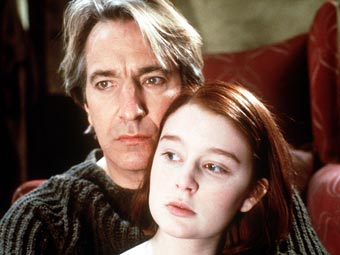
How a Peter Pan-related film starring Alan Rickman and Hugh Grant escaped my attention when it was released, I don't know. It was only when my research for The Stowaway led me to the original version of the story--Beryl Bainbridge's 1989 novel An Awfully Big Adventure--that I found there was a 1995 movie version as well.


Directed by Mike Newell in a sharp turn away from the levity of his 1994 Four Weddings and a Funeral, it's the story of 16-year-old Stella Bradshaw, who, having no other career interests or aptitude, goes to work for a struggling Liverpool theater company. Stella is romantically inclined toward Meredith Potter, the theater's director (Hugh Grant), never seeing that his interests are otherwise inclined. It's the attention of another actor altogether that she attracts, and reciprocates to some extent. Stella is obtuse, self-interested, stubborn, and often hilarious. She's also confident and calculating in a way that ensures her survival in this group of other self-interested and highly dramatic people.


"The best Captain Hook there has ever been," one of the troupe says of P.L. O'Hara (Alan Rickman), the famous actor who returns to Liverpool to take the place of an injured troupe member--and also for reasons of his own. While I'm personally partial to Jason Isaacs' 2003 movie Hook, and would never be able to forget I was watching Rickman, I can't deny his Shakespearian appropriate for the character in J.M. Barrie's play. And I can certainly see O'Hara's appeal to various members of the theater company. As well, there's a gravitas to Rickman's O'Hara that brings across the bittersweet nature of the text.

The movie makes reference to O'Hara playing Richard II on stage, which dovetails with Rickman's character Alexander Dane in 1999's Galaxy Quest, an actor bitter that his success comes from his time on a TV space adventure rather than because of his stage portrayals of Richard III. Rickman himself studied Shakespeare with the Royal Academy of Dramatic Art. And it was with the Royal Shakespeare Company that he played the Vicomte de Valmont in Les Liaison Dangereuses in 1985, which led to a Broadway run and a Tony Award nomination.  While Rickman may be best known as a film actor, he also enjoyed great success on the theatrical stage--not unlike P.L. O'Hara.


In some ways this story is better suited for the book, which received a Man Booker Prize nomination. Some of the important plot developments become Hollywood-ized in the movie in a way that robs them of their full impact and emotion, and Bainbridge's black humor is sometimes lost to sentimentality. It's one of the few short novels that I don't think skimps on character development--in fact, I think Bainbridge's sometimes acid approach works to flesh them out in a way the film does not. Stella, in particular, is calculating in a way I don't think comes across fully. But the cinematic version has the performances, and they're worth seeing. Hugh Grant plays against his loveable romantic lead persona, and I took notice of Prunella Scales, otherwise  known as Basil Fawlty's wife Sybil in Fawlty Towers, as actress Rose.

Clare Woodgate is a lovely Stella with an interesting story of her own: After being turned down for the role after her first audition, the 20-year-old, middle-class, Essex actress returned in the persona of a 17-year-old redhead from working-class Liverpool named Georgina Cates and read for the part again. Not only did she get the part, she received an Actress of the Year nomination for her performance from the London Critics Circle Film Awards in 1996.

Rickman, director Newell said, wasn't pleased with Cates's dissembling. "He treated Georgina very tactfully, presuming that she was sexually inexperienced and could get upset by the scene. Well, who knows, maybe she was."


I was surprised to realize I'd seen Cates before, in the 1998 movie Clay Pigeons, which I've always thought is underrated and which features a couple of my favorite songs from the band Old 97s. Proving once again that everything in my life seems to circle back around to Peter Pan and Captain Hook and The Stowaway.

An Awfully Big Adventure is also available as an audiobook read by Paul McGann, whom I think would be an excellent Hook actor in his own right, if only he were as tall as the character as described by J.M. Barrie.