navigation

Tuesday, November 11, 2014

Further travels (some of relevance to the book)


While my husband and I didn't make our trip to the Tower of London only to see the Blood Swept Lands and Seas of Red installation by Paul Cummins and Tom Piper, it would have been worthwhile to do so. We missed a visit to the exhibit by the Queen that day, which is likely for the best as no doubt we would have seen mostly crowds and not much art.

Each of the 888,246 red ceramic poppies commemorates the death of a British soldier in World War I, and the final poppy was placed on Armistice Day, November 11. Originally scheduled to be taken down on November 12, the poppies will be left in place for an additional week before parts of the exhibit are taken on tour around England.


More information can be found at the British Legion website, and Huffington Post has some lovely photos of the poppies at twilight.


View from the Serpentine Bridge, facing east
into Hyde Park

While I wasn't able to spend quite enough time in London and Bristol to see everything I'd hoped to visit for research purposes--perhaps that was an impossible goal--I certainly made the most of the hours I had.

The Stowaway takes place in 1908, but the famous statue of Peter Pan in Kensington Gardens wasn't erected till 1912, Given the likely reaction of the Captain to its presence, this is probably just as well. But I could hardly visit London without seeing it for myself, could I? The Captain and Vivian do walk through the park and over the Serpentine Bridge as they make their own way through London, so that landmark did qualify as research.


A rare photo of the writer in the wild.

A current modern touch is a plaque with a QR code which a visitor can scan with a smartphone to hear "Peter" talk. While he sounds suspiciously adult, he is every bit as cocky as his literary counterpart.


Peter is of course the star attraction, but fairies and rabbits cluster about the base of the statue, and they deserve attention as well.


Vivian and James have less time to visit the landmarks of London than did I, but their travels do take them past Westminster Abbey and past the Houses of Parliament. Also a certain large clock there is familiar to anyone who has ever seen a movie or illustrated book of Peter Pan.


St. Katharine Docks, where the Jolly Roger moors during its time in London, are just beyond Tower Bridge and to the left.

From London we traveled to Bristol. While there are no direct Peter Pan associations to be found in Bristol, the city was the inspiration for the beginning of Treasure Island, which was an influence on J.M. Barrie's book. Also, Wendy Darling was given her first name by Margaret Henley, the daughter of William Ernest Henley--Robert Louis Stephenson's inspiration for the character of Long John Silver, though by all accounts a far more upstanding citizen.


The Llandoger Trow pub is said to have been the inspiration for the Admiral Benbow tavern in Treasure Island.


Bristol Castle has no connection at all to Peter Pan, but it is a beautiful piece of architecture near the city's Floating Harbour on the River Avon.


This weathervane in Bristol does, at least, have a maritime connection.

Friday, October 24, 2014

Following my characters through London


This blog has been on a brief hiatus while my husband and I visited the cities of London and Bristol for our fifteenth wedding anniversary. Of course, this was also a significant Research Opportunity, and I felt it necessary to follow as best I could in the footsteps of Jas. Hook as he shows Vivian Drew the sights of London. From the approach through Tower Bridge (though we saw it from a river tour boat, rather than arriving from the other direction aboard a tall ship) we went,


to the Savoy Hotel on the Strand in Central London, overlooking the Embankment and the Thames River, tracing the path of the characters in The Stowaway.


The Savoy is celebrating its 125th anniversary this year, and was refurbished earlier this century to include both art deco and Edwardian style. The main dining room, where Vivian and James dine, is now Kaspar's, which serves fantastic seafood. The restaurant also continues to serve its traditional pĂȘche Melba, peaches with vanilla ice cream and raspberry sauce. Rather than being served with a sculpted-ice swan, as it was when it was created in 1892, today's version includes a "white chocolate sphere," which melts when topped with the warm sauce.


The redecorated room includes a new "winter garden gazebo," but is still recognizable as the venue for this 1907 New Year's Eve celebration.


James's family keeps a townhouse in Mayfair (much to Vivian's disappointment, as she expected a grand house on a large property). Mayfair is now under a great deal of construction, and many of its homes are now owned by absentee billionaires from other countries.


The National Gallery, however, is much the same, down to the paintings by J.M.W. Turner,


and so is the quick walk along wide, pale paving stones to the nearby Haymarket Theatre Royal. Noted actress Lillie Langtry was appearing in a scandalous comedy called A Fearful Joy in 1908, whereas we saw a production of Great Britain, a satire of tabloid culture and the Rupert Murdoch newspaper phone-tapping scandal. 


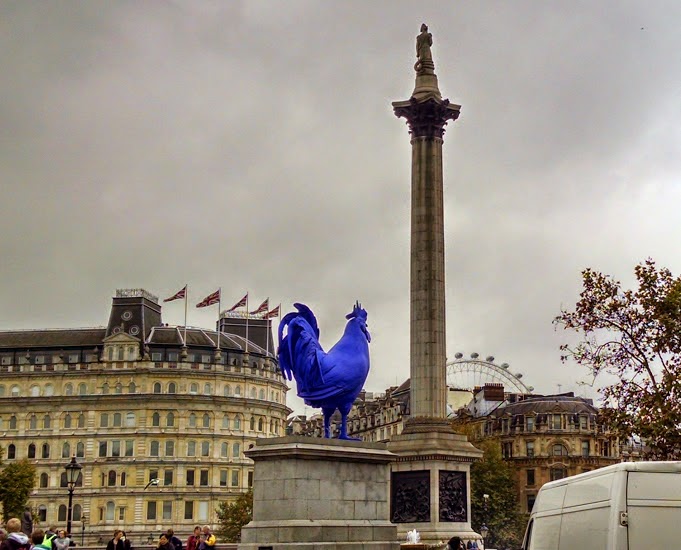
One of the advantages of writing about a city so rich in history is the knowledge that so many of the places my characters visit are the same, or nearly the same, now. I could easily summon Vivian's delight in the landmarks she had never expected to visit Of course there was no Millenium Wheel in 1908, or--I suspect--a blue rooster on a plinth in Trafalgar Square.


Thursday, September 25, 2014

A little bird broken out of the egg

Somewhere between the boy hero of Disney studios and the dangerous, complicated lead of Brom's The Child Thief lies the real Peter Pan.


J. M. Barrie's original Peter is neither the spirit of sweetness nor the incarnation of malice. This Peter is nothing more or less than a small boy who is static, unchanging, embodying both the innocence and heartlessness of a child who doesn't grow up and therefore never learns to be kind.

Peter himself says, "I'm youth, I'm joy, I'm a little bird that has broken out of the egg." To an extent, that's true, and it's long been a popular way of considering him. Unfortunately, this charm is tempered with a lack of practicality and ability to exasperate, as the Darling children see over and over on their flight to Neverland.

Barrie tells us how Peter acquires food for himself and the others by stealing it from the beaks of passing birds, which John and Michael find delightful.

But Wendy noticed with gentle concern that Peter did not seem to know that this was rather an odd way of getting your bread and butter, nor even that there are other ways.


One of Peter's more alarming traits manifests when the children fall asleep from exhaustion and tumble through the sky.

Eventually Peter would dive through the air, and catch Michael just before he could strike the sea,and it was lovely the way he did it; but he always waited till the last moment, and you felt it was his cleverness that interested him and not the saving of human life.

And he's never completely trustworthy.

Indeed, sometimes when he returned he did not remember them, at least not well. Wendy was sure of it. She saw recognition come into his eyes as he was about to pass them the time of day and go on; once even she had to tell him her name.

He was very sorry. "I say, Wendy," he whispered to her, "always if you see me forgetting you, just keep on saying 'I'm Wendy,' and then I'll remember."

Carelessness is integral to Peter's character, as is the way he tries on identities. On one level, Peter wants to be a captain, wishes to play at being a father. But he wants these roles never to be truly real.

I was just thinking," he said, a little scared. "It is only  make-believe, isn't it, that I am their father?"

"Oh yes," Wendy said primly.

"You see," he continued apologetically, "it would make me seem so old to be their real father."

"But they are ours, Peter, yours and mine,"

"But not really, Wendy?" he asked anxiously.

"Not if you don't wish it," she replied; and she distinctly heard his sigh of relief.


He inhabits his roles briefly, and they leave no real impression upon him. It's as if everything is make-believe, including the consequences of his actions.

He often went out alone, and when he came back you were never absolutely certain whether he had had an adventure or not. He might have forgotten it so completely that he said nothing about it; and then when you went out you found the body; and on the other hand, he might say a great deal about it, and yet you could not find the body.

Peter has the callousness of the child who doesn't understand death, or the fact that people have lives and concerns of their own that have nothing to do with him."I forget them after I kill them," he says of the pirates in Neverland. Because Peter Pan can be heartless--with his indifference towards those he kills, and the way he "thins out" the population of lost boys as they become older--it's easy to see where the dark interpretations come from. But this is a simple interpretation of a much more complex character.


Peter even forgets Tinker Bell after the Darling children leave Neverland and the fairy dies of old age. Most people aren't real to him once they pass off the screen of his immediate life, Wendy being the exception, and that not complete. "Being present" is held up as a high ideal in our culture, but Peter warns of the risks that come if one disregards the richness and depth that present and past bring to existence. His is the peril of the child who refuses to learn and mature.

John and Michael forget about their parents during their time in Neverland, much to Wendy's distress. She is the only one mature enough to realize what is happening, and her attempts to keep those memories alive make up a significant part of Barrie's book. In contrast, the lost boys, who have no such memories to draw upon, do their best to construct pasts for themselves.

Peter's world is one of adventure and novelty and joy. And yet, he cries sometimes in the night, and is at least as unsettled than triumphant when he takes over the captainship of the Jolly Roger. On some level, he knows all is not right with the way he has chosen to live. The scene where the Darling children return home brings into relief what Peter has lost in his refusal to grow up.

There could not have been a lovelier sight; but there was none to see it except a strange boy who was staring in at the window. He had ecstasies innumerable that other children can never know but he was looking through the window at the one joy from which he must be forever barred.


And herein lies the essential sadness of Peter Pan. Courageous in facing the dangers he sets up for himself to defeat, and yet so fearful of the prosaic unknown he does everything he can to avoid it. In the end, he is more lost than the boys who follow him.

Friday, September 12, 2014

A boat festival and research too

To no one's surprise, I've discovered I love the wooden boat festivals of the Pacific Northwest. To find one in Port Townsend--one of my favorite towns to begin with--with the Lady Washington and Adventuress in attendance...yes, this may in fact be where I was last weekend. 


Because one of the classes offered at the boat festival was on celestial navigation, I was able to get some critical research done for The Stowaway. I've been making a point of learning alongside Vivian Drew as she becomes part of the crew of the Jolly Roger, and using a sextant is an important element of that. I've got my book and my video, and yes, my sextant, but getting an actual lesson in how to use it was an unexpected joy.

The basic math wasn't bad--trigonometry was the only math class I liked in high school, so I knew I'd likely be all right in that regard. Actually taking a reading the sextant was more of a challenge, though. Once I figured out what I was supposed to be doing, I had it. Getting there was harder, especially with other people standing about waiting their turn, but I absolutely could not give up until I saw what I was supposed to through that eyepiece. And I did. And now Vivian can too.


Now I also get to find out if my brass display sextant works for more than display. Although I now know all my readings will be 48 degrees, if they're correct. Possibly that's not a problem.


The festival ends with a several-hour parade of about 300 boats and ships. It's possible (if pricey) to be on board the Lady Washington during the sail-by, my sources tell me---something to consider for next year.


Thursday, August 21, 2014

A scent of 1908

"Four hours of research for two lines of text" is my oft-repeated joke. And sometimes an evening spent doing research ends in a scene abandoned on the cutting room floor, so to speak. I share both my research into Edwardian perfume and its related outtake here.

Jicky perfume was created by the house of Guerlaine in 1889, and was one of the first perfumes to contain synthetic essences. As described by a variety of sources, Jicky's notes included lavender, citrus, and rose over a base of civet (a scandalous scent!) and vanilla. Legend has it the perfume was named for a woman named Jacqueline with whom AimĂ© Guerlain fell unrequitedly in love, but more likely it was named after his nephew Jacques. It was marketed as a women's scent, but proved equally if not more popular with men.


Jicky is still available- in fact, it's the oldest perfume in continuous production. While I'm tempted to try some for myself, I know that classic fragrances have mostly been modified for modern preferences, and I wouldn't have the same experience with it as do Vivian and James in this brief scene from The Stowaway, which takes place shortly after their arrival at the Savoy Hotel in London.

*  *  *

Deep in my brown leather trunk I discovered an unfamiliar green velvet bag. “And what might this be, Lord Jim?”

“A gift for you, compliments of 'Becca. It seems she enjoys outfitting her new customer. Also I told her in my last letter about our unpleasant experience with the lavender, and she offered to send along something we would like better.”

From the bag I withdrew a small, light-green velvet box. I traced the looped House of Guerlain emblem printed in gold upon the lid before I opened it, drawing out the moment. “Jicky perfume!" Any aspirations I may have had of appearing sophisticated were handily overcome by the sight of the beveled glass bottle in the box.

Jicky in its 1908 bottle

If James liked to see me happily surprised, this must have been all he could ask for. He leaned over my shoulder, one long ringlet brushing my cheek, as I held the bottle gingerly in both hands. “'Tis only proper to warn you, It has a lavender note, but 'Becca promises it will not remind us of our mothers. And we can both wear it, if the lady doesn't object.”

“I would be honored to share a scent with you, sir.” I turned my beaming face to his. “James, how did she know? I've always wished for a bottle of this.”

“Good. You can wear it tomorrow, and at least something worthwhile will have come of the day.”

“Let's try it tonight and make sure we do like it, shall we?” I unscrewed the top and sniffed. “Oh, I don't think that will be difficult at all.”


I learned ever more about Jicky and the House of Guerlain researching for this post. Some sources:
Fragrantica, Monsieur-Guerlain, Now Smell This. And there are some interesting first-hand accounts of people's experiences with Jicky on the web as well.


Friday, August 8, 2014

Tiddely-om-pom-pom

Vivian Drew may have felt isolated in her home of Pinbury Down, Devon, but she had access to the London Illustrated News--if not the most recent editions--with occasional expeditions to the city of Plymouth so that she was not entirely remote from the trends of the day. A common form of entertainment for the Edwardians was singing popular songs, and sheet music was readily available.


"Daisy Bell" (known better as "A Bicycle Built fur Two") is one of those songs, and also one I like to sing, particularly to a cat of my acquaintance named Daisy. I at first considered mentioning it in The Stowaway, but it's so commonly known I don't think it provides much period flavor. So I delved into Edwardian popular music and decided that "I Do Like to Be Beside the Seaside," written in 1907 by John A. Glover-Kind, would be a perfect choice for Vivian to spontaneously sing on board the Jolly Roger, to the surprise and delight of the Captain. He's not one to frequent music halls or to shop for sheet music when he's in port, and this song provides a window into a world he is only tangentially a part of.


Mark Sheridan's 1909 performance


As it turns out, "Seaside" is probably at least as well known in the UK as "Daisy" is in the States. (UK readers, can you back me up on this?) as demonstrated by the number of covers I've found. For example, it makes appearances in two songs by Queen ("Brighton Rock" and "Seven Seas of Rhye") and two episodes of "Dr. Who." And it hops the pond to appear in the 7:18 episode of "Navy: NCIS." YouTube has many versions of the song, including this strangely adorable cover from "Thomas the Quarry Engine."


The popularity of the song means I don't need to take up space in an already-crowded manuscript to includ the lyrics, but I shall do so here:

Oh! I do like to be beside the seaside
I do like to be beside the sea!
I do like to stroll along the Prom, Prom, Prom!
Where the brass bands play:
"Tiddely-om-pom-pom!"
So just let me be beside the seaside
I'll be beside myself with glee
And there's lots of girls beside,
I should like to be beside
Beside the seaside!
Beside the sea!


And here is Basil Rathbone, in The Adventures of Sherlock Holmes (please ignore the fact that the movie is set fifteen years before the song was written). This version is the most appropriate under the circumstances as Sir Arthur Conan Doyle was the most competent member of J.M. Barrie's struggling Allahakbarries cricket team.

Now I'm going to sing this song for the rest of day. Perhaps you will too.

Thursday, July 24, 2014

An afternoon at sea

Two weeks ago, my friend and I went on an Evening Sail on the brig Lady Washington out of Anacortes, Wash. I can't imagine letting a summer go by without at least one sailing now that I've discovered there are tall ships so close to home, thanks to the Grays Harbor Historical Seaport Authority, and I had the excuse of needing to refamiliarize myself with exactly what it's like to be on board a brig.

I'd been wondering when the crew of the Lady Washington would start to recognize me. The answer is "now." They not only recognize me, they remember that I'm working on this book. I found this more than a little gratifying.


Tall ships in Anacortes, WA
--the Indian Chieftain
and the Lady Washington

While I think of the Jolly Roger as being slightly larger than the Lady, she's still not a huge ship. A brig is not an enormous vessel like the galleons I've seen in numerous (inaccurate) interpretations of Peter Pan. Spending time in a similar space helps me understand what it would be like to live there alongside a handful of people one considers friends, a few others who don't take sides, and some who can only be considered enemies. It's pretty close quarters for a crew with an average size of fourteen, even if Vivian Drew does have the captain's cabin and often the state room to take refuge in.


As I'd hoped, I found the ship familiar enough now that I could easily imagine what daily life is like for Vivian once she's part of the crew. I wanted to make special note of the background details--the squeak of the pulleys, the sound of footsteps running on the deck, the quality of the wind on a calm day--so that her experience would be real to me (and, I hope, to the readers of her tale). I walked about the ship and thought about waking every morning to realize this was now my home. How I would become accustomed to the intricacies of the rigging and the dimensions of the decks. How I would feel to have a position of value among the pirates of the Jolly Roger.


Even though our sail wasn't a Battle Sail, we got a bonus cannon shot, which was as fun as I remembered from my first sail on the Lady. And I got a good look at the ordnance locker this time, which will prove useful to my story.