navigation

Tuesday, November 12, 2013

Oh, ambivalence

So apparently Warner Bros. is planning a new Peter Pan movie . In talks with the studio is Joe Wright, the director behind Atonement, The Soloist, and Hanna, and who directed Keira  Knightley in Pride and Prejudice and Anna Karenina.

Good director, yes...but I have to agree with the critics who think it may be too soon to do this again after the 2003 adaptation, which got so much of it right. Still, this film wouldn't be finished for several years, and after all the dark Peter Pan adaptations (I include you, "Once Upon a Time"), a portrayal of the original Peter might be welcome.


And I'm unnerved at the thought of the casting. I have yet to think of an actor I would cast as Captain Hook, so I'm prepared to be disappointed already.

Of course I can't think about any of these without wondering how they might affect receipt of The Stowaway (realizing, of course, all that must take place first to get it into people's hands to begin with). There's part of me that that thinks every departure from the original will make people less likely to accept my retelling of Barrie's work. And part of me that worries the entire world will be burned out on Peter Pan altogether before The Stowaway is even in finished form. And yet there's the small hopeful voice I usually try to keep squashed says that retelling the original will make readers more receptive to my version, because they'll have the background that makes it all the more relevant.

It's best not to think about any of this too much, I generally decide, which is hard to do when I feel like I have to keep up with all of these developments so I don't accidentally crib from anyone else's work. Really, you're glad you don't live inside my head.

Thursday, November 7, 2013

Yep, still fun


Tonight I was looking for examples of naughty slang to determine if an Edwardian English pirate might find the word "aspic" funny for the same reasons a modern American would. (The answer seems to be yes--although naturally he would pronounce it "arse-pic" as he snickered, at least before the Captain raises his hook and Vivian Drew steps deliberately on his instep with the slender heel of her boot.)


And I was lucky enough to find A Dictionary of Slang and Unconventional English on Google Books, and even luckier to find a used two-volume hardback set of the actual book on AbeBooks.com. This looks like the best source on slang I've ever seen. It's full of everything. I think I could read this for hours and be entertained the entire time.

At the risk of turning this into a promotional post (too late! the audience cries), AbeBooks has been my best friend for both collecting and research and it deserves to be recognized. They've had almost everything I've looked for, and with a range of conditions and prices. I can find an illustrated Peter Pan in near-perfect condition, or a beat-up paperback to write notes in or a former library book for nostalgia purposes. And I can find recreational reading there too (for the little I get to do of that these days).

Uncharted


The Neverland map we're familiar with was not drawn by J. M. Barrie, but rather Walt Disney studios and many artists thereafter. There's no map in the original book, and given Barrie's description of Neverland, it's no wonder.

"...the Neverland is always more or less an island, with astonishing splashes of colour here and there, and coral reefs and rakish-looking craft in the offing, and savages and lonely lairs, and gnomes who are mostly tailors, and caves through which a river runs, and princes with six elder brothers, and a hut fast going to decay, and one very small old lady with a hooked nose. It would be an easy map if that were all, but there is also first day at school, religion, fathers, the round pond, needle-work, murders, hangings, verbs that take the dative, chocolate pudding day, getting into braces, say ninety-nine, three-pence for pulling out your tooth yourself, and so on, and either these are part of the island or they are another map showing through, and it is all rather confusing, especially as nothing will stand still.

Of course the Neverlands vary a good deal. John's, for instance, had a lagoon with flamingoes flying over it at which John was shooting, while Michael, who was very small, had a flamingo with lagoons flying over it. ...on the whole the Neverlands have a family resemblance, and if they stood still in a row you could say of them that they have each other's nose, and so forth......Of all delectable islands the Neverland is the snuggest and most compact, not large and sprawly, you know, with tedious distances between one adventure and another, but nicely crammed."


The only locations Barrie mentions specifically in Peter Pan are the Neverwood, Mermaid Lagoon, and Marooner's Rock. So some of the locations we think of now as part of Neverland--Skull Rock, Cannibal Cove, Crocodile Creek--are Disney creations. This sent me off to do a bit of fact-checking when I first began The Stowaway so I wouldn't inadvertently crib from Disney. Now it's a handy reference point for me as to whether artists and writers are using Barrie or Disney as their starting point.

According to KStirling, contributor to the jmbarrie.co.uk message board (now mostly inactive, which is unfortunate for my research), a scenario Barrie wrote for a proposed silent film of his book was reprinted in a book called Fifty Years of Peter Pan by Roger Lancelyn Green. (I've found copies of the book online, but haven't committed yet to spending what it would cost to have one.) In his screenplay, Barrie wrote:

"We see the island all glorious and peaceful in a warm sun. We see the whole of it as in a map, not a modern map but the old-fashioned kind with quaintly exaggerated details. I have a map of the Never, Never Land, in this style which should be reproduced." The Beinecke Library at Yale has Barrie's actual film typescript, but I haven't been able to find out if it contains the map.

Wikipedia tells me users of Colgate-Palmolive's "Peter Pan Beauty Bar with Chlorophyll" received a copy of this promo map for the Disney film by sending in three wrappers with fifteen cents. I want one.

So, as it stands, the only maps of Neverland are from the Walt Disney film or are based on it. In The Stowaway, the Captain has a map of the island on his wall, useful as he makes excursions to and from and around it--but I make no claims as to the map's veracity, or how often its features may change.

Ultimately, I suppose the best description of Neverland's location is from Herman Melville's Moby-Dick: "It is not down on any map: true places never are."


Tuesday, November 5, 2013

Starcatcher vs. Starcatchers

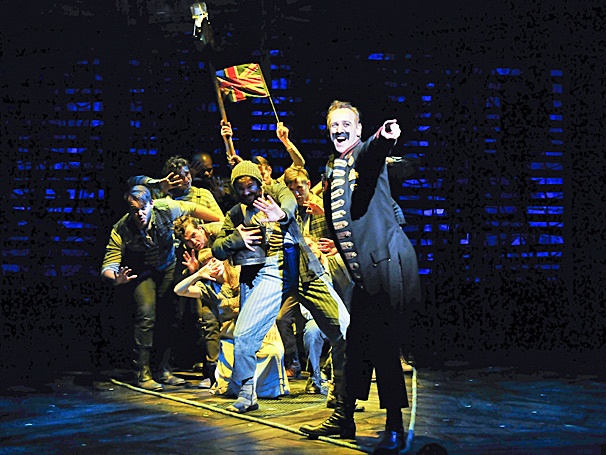
I almost avoided the play because I don't care much for the book it's based on--but I'm glad I didn't let that keep me away in the end. I thoroughly enjoyed the production I saw at the Moore Theater in Seattle on Saturday, and there were a number of ways in which I thought it improved on the book.

For one, it benefited greatly from compressing the exposition-heavy plot of the book, streamlining the original antics of three groups of sailors chasing each other's ships and each other along the high seas and around an island. The simplification made the action cleaner and easier to follow, and condensing the cast of characters allowed more development in the ones who remain. Peter, in particular, traveled an arc far from that of the natural leader he is in the books, with more emotional resonance. And parts of the book that annoyed me for various reasons were easier to take when handled briefly and with the sense of fun the cast brought to the show.


The theatrical production.especially benefits from the revision of  Black Stache--the future Captain Hook--a confident and flamboyant pirate who brings his fate upon himself and faces it with aplomb. He's not Barrie's Hook, but neither is he the Black Stache of the book, who had none of the elegance and education of the original Captain, and whose depiction I honestly don't enjoy. Instead he is his own character, and as such I could appreciate the role on its own merits, adding to rather than detracting from the play. Also, I liked the performance by the actor at the Moore, John Sanders, even more than what I've seen of Tony-winner Christian Borle's performance, because Sanders added a touch of Groucho Marx to the character that I found delicious.

Starcatcher the play also makes more clever references to the Peter Pans of Barrie and Disney, and makes the whole more of a recognizable prequel. I realize that's not what most audience members may be there for, but the passing allusions and wordplay made me think the playwright cared as much about the original source as I do. Aside fromthat, the stagecraft, especially the clever use of simple props, and the few songs there are (why are there not more songs?  she cried) helped make this a show I enjoyed far more than I expected to.

My quibbles with the books, I'll save for another post. There are lots of those left to come this month, after all.

And yet more Tink

My new favorite Tinker Bell story comes from an episode of "This American Life" I heard on NPR over the weekend. While a lot about the disaster performance of Peter Pan it described entertained me--from the Captain accidentally flinging his hook into the audience, to the flying apparatus dumping the children on the stage and dragging them through a field of papier-maché mushrooms, to the fire department response to one of the Indians spraining both ankles descending a rope ladder--my favorite part was an actual choice by the stage director. She chose to represent Tinker Bell with a light bulb on an extension cord, which would descend from above to be addressed by the cast. I still laugh every time I picture it.


And now here's Mindy Johnson's new book, "Tinker Bell: An Evolution," which explores in depth how Disney's version of the character came to be. Apparently everyone really is interested in the pixie. Surely Tink would be gratified at the attention.

A question I've had, which has been answered by the book: Tinker Bell was originally named Tippytoe and had speaking lines, but J.M. Barrie decided chimes would provide a better voice for her. One of the bells that traveling tinkers used to call customers to their wagons was used for this purpose in an early stage production, which led to her name and presumably to her trade in Barrie's book Peter and Wendy. I find it hard to imagine her now as anything other than a pots and pans fairy.

Sunday, November 3, 2013

Why Manaus?

When I first came across mention of Manaus, Brazil, in J.M. Barrie's "Hook at Eton" speech, I wondered why Captain James Hook would travel there. It took only a bit of research for me to understand the draw.

Manaus, Brazil, at the juncture of the Rio Negro and the Rio Solimões--the Amazon River--was one of the finest cities in the world in 1908,when The Stowaway takes place. The rubber trade had brought incredible amounts of riches to the city, plain to see in the houses and storefronts and cultural icons like the Teatro Amazonas Opera House. I was lucky enough to find some photos from that very year on a Portuguese website.


While the heady days of the rubber trade have passed, Manaus is still a vibrant modern city with a population of two million, making it the eighth largest city in Brazil. It's a draw for tourists who want to experience both the urban life of Brazil and the nearby landscape of the Amazon.


Saturday, November 2, 2013

Glad I went: Peter and the Starcatcher

Quick impression of Peter and the Starcatcher: I enjoyed it considerably more than the book it's based on, and I'm glad I put aside my misgivings and gave it a chance.


I liked the play's Black Stache considerably more than the book version, the stagecraft was clever and fun, and the songs strong (if not numerous). I have quibbles in general with the origin stories presented in the book, but even those didn't bother me as much in the context of the play.

More later when I'm not in "finish today's blog post quick!" mode.