navigation

Showing posts with label Theater. Show all posts

Thursday, January 9, 2014

Peter and the panto tradition

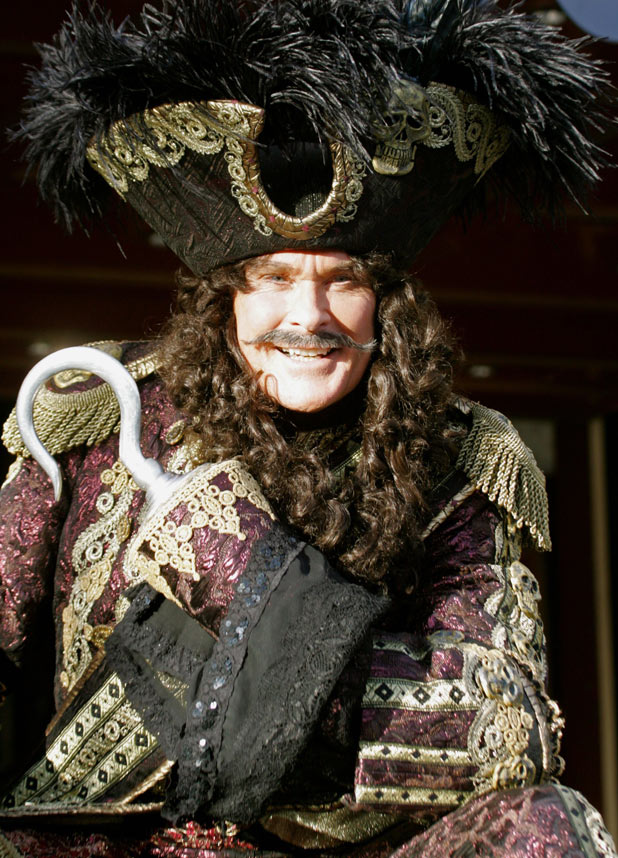
As an American, my knowledge of the English pantomime tradition has been minimal and not first-hand until recently. And true to form, I became curious about it after learning about actors like Henry Winkler and David Hasselhoff playing Captain Hook in Christmas panto interpretations of Barrie's play.

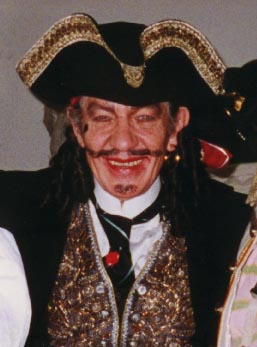
Henry Winkler as the Captain

I was lucky enough to discover Seattle's own Fremont Players doing a panto of Dick Whittington and His Cat over the holidays, so I can now write this from the point of view of the initiated. I can understand why this is a popular holiday activity after taking part in the fun myself.


Pantomime has a strong foundation, arising from the tradition of commedia del'arte, which traveled from Italy to England in the 1600s. When Charles Dickens connected panto and Christmas in his writings, it became an expected part of the holidays for children in England and now beyond. Panto performances are traditionally loose versions of folk or fairy tales, with stock characters and scenes, contemporary references, and humor for all ages in the form of slapstick and double entendres. Popular actors from stage, film, and TV are a particular draw in larger theater productions, and have been since the late 1800s.

While panto becomes increasingly popular in the US, with a recent feature on CNN explaining it to the American audience, British critics debate its demise. Not all theater critics agree that this is imminent, or even close to occurring.

I couldn't find the premiere date of the first Peter Pan panto (I am not going to try to say that five times fast), but the only adaptation allowed by copyright until recently was the 1953 Disney film, so panto versions of it are fairly new. J.M. Barrie's original play doesn't incorporate many panto elements, although it does include audience participation (clapping to bring Tinker Bell back to life), and actors dressed as animals (Nana and the crocodile). Peter was originally played by a woman not because of a cross-dressing tradition, but because children weren't allowed to work in the theater past 10 pm. Nor does the original play include a cross-dressing Dame, naughty humor, singalong, slapstick,or a chorus. But all these have been easily added, even the Dame as a human nurse (as opposed to Nana the dog) or a female pirate.

Mermaids of the alarming variety

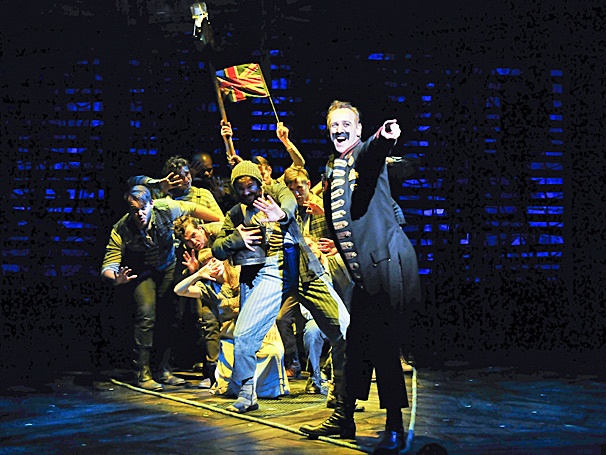
Broadway production Peter and the Starcatcher includes many panto elements--slapstick, a chorus, the cross-dressing Mrs. Bumbrake, double entendres and pop culture references, cultural satire--thereby tying the production to both Barrie's play and the panto tradition. (Starcatcher and Dick Whittington also both included a boat, a ship wreck, and a desert island--none of which I knew to expect in the latter, although I realize how unlikely that sounds in retrospect.)

The Fremont Players did a panto Peter Pan in 2011, but I"m glad I didn't discover them till Dick Whittington. I had no objection to shouting insults at the odious King Rat. But while I love a campy Captain Hook, I recoil at the thought of booing and hissing the poor man, or suffering the popcorn hurled in my direction if I cheer instead.

Friday, November 15, 2013

An unpopular opinion, and the reasons why

I discovered in looking for images for this post that every reviewer in the world loves the Peter and the Starcatchers books. Well, I do not. And I'm going to say why with spoilers, and many words, so you are hereby warned.


 I came home from Peter and the Starcatcher, the play, so wanting to spend more time with the characters that I cracked open Peter and the Shadow Thieves, the second in the Barry/Pearson series, and then went on number three, Peter and the Secret of Rundoon. And thus I remembered why I almost didn't give the play a chance.

First off, I freely admit to being put off by the complete departure from canon, from the character of Peter to the reason why Neverland exists. I have to accept here that one of my personal peeves is the reduction of the wondrous to something easily explained by a prosaic element. Starstuff is not prosaic in itself, but it's the single cause of literally all life in the universe and the reason for the cosmic battle between good and evil, life and the void. (How the diabolical Lord Ombra can be an ambassador for the void, yet exist, is not explained.)

Starstuff is the reason as well for why Peter doesn't age and can fly, the presence of mermaids (who began as fish exposed to starstuff--an explanation which the play turns into an Edwardian music hall number to great success), the menace of the crocodile, even Tinker Bell--a bird shaken up with starstuff to create a fairy. So there are no other fairies, no actual magic on the island, no ability to fly that doesn't come without assistance from--for all intents and purposes--aliens. A trope that is another pet peeve of mine. And Peter is not merely a boy who refuses to grow up, but a boy from a Very Important Family with a Purpose.


The play, doing it right.

Starcatchers the play takes such elements and magnified them to a silliness that nearly redeems them--the tribal chief was held captive in English kitchens, and sprinkles his phrases with cooking terms, thus making him drolly individual. Nods to the pantomime and vaudeville traditions tie the play in with decades of theatrical performances of Peter Pan. And references throughout to the source material, British history, and current events--often from the mouth of Black 'Stache--make it feel like part of the tradition. I don't feel this way about the books, which seem barely connected to the original source at all. Dave Barry admits to not having been a real Peter Pan fan growing up, and I suppose we see here the result of taking on a beloved classic without the heart attachment to it than others have.


Writing advice frequently encourages writers to keep upping the stakes, upping the stakes. Starcatchers the book series shows the danger in that, when the stakes become so universal as to rob them of any personal resonance. The stakes in the series become so abstract that the mythic quality of Barrie's story is lost. Peter Pan is a mythic presence because he expresses personal truths--the desire to stay young, the sacrifices involved in doing so, the nature of loss and forgetfulness. Another battle between the forces of good and evil in the universe simply does not resonate with me in the same way. I've read that/heard it/seen it so many times now, it's simply another flavor of something that has nothing to do with my own experience. Yes, the annihilation of the universe is a frightening thought. So is the annihilation and loss of many other things that I am more likely to experience for myself.

More specifically, there are aspects of Pearson/Barry's Starcatchers that would bother me in any context. Characters who are not well-educated and well-bred are fair game for mockery, such as the pirates. The evil land of Rundoon is set in a desert, where the people wear robes and turbans and ride camels--can we tell it the book was written post 9/11? (Published in 2007, to be precise). The problematic Indians of the original story are transformed into nearly-as-problematic Pacific islanders called the Mollusk Tribe, led by Fighting Prawn--not exactly dignified. While Pearson/Barry occasionally seem to realize the consequences of colonialism, the play actually calls attention to them with jokes, and don't approach the story from the books' viewpoint of aristocratic natural leaders, which among other things, leaves any number of interesting stories untold and viewpoints unexpressed.


Lovely art by Greg Call, as always,
but why has Molly become inexplicably blonde?

I like the character of Molly, but I find little in these books as a whole to identify with, and I'm sure there are young adults reading these books who feel the same way. It's the authors' choice to approach their subject this way, of course, but it does seem to me that it adds to a large collection of the same, rather than breaking the new ground they surely intended. And while the books are lauded for their imagination, I find too much I've seen before. Molly and Teacher the mermaid are both unusually beautiful. (I miss Hermione Granger.) Tubby Ted is obsessed with food. Battle between good and evil. Right. Got it.

Examining my responses to the books as opposed to the play has been interesting, and you can look forward to more on this. (Sorry. No, wait, I'm not.) Specifically, I've had to analyze what types of fairy tale retelling I like and which I don't, and why. And then there's the Starcatchers books' treatment of Captain Hook, which merits its own post. (That you probably knew to expect.)


Tuesday, November 5, 2013

Starcatcher vs. Starcatchers

I almost avoided the play because I don't care much for the book it's based on--but I'm glad I didn't let that keep me away in the end. I thoroughly enjoyed the production I saw at the Moore Theater in Seattle on Saturday, and there were a number of ways in which I thought it improved on the book.

For one, it benefited greatly from compressing the exposition-heavy plot of the book, streamlining the original antics of three groups of sailors chasing each other's ships and each other along the high seas and around an island. The simplification made the action cleaner and easier to follow, and condensing the cast of characters allowed more development in the ones who remain. Peter, in particular, traveled an arc far from that of the natural leader he is in the books, with more emotional resonance. And parts of the book that annoyed me for various reasons were easier to take when handled briefly and with the sense of fun the cast brought to the show.


The theatrical production.especially benefits from the revision of  Black Stache--the future Captain Hook--a confident and flamboyant pirate who brings his fate upon himself and faces it with aplomb. He's not Barrie's Hook, but neither is he the Black Stache of the book, who had none of the elegance and education of the original Captain, and whose depiction I honestly don't enjoy. Instead he is his own character, and as such I could appreciate the role on its own merits, adding to rather than detracting from the play. Also, I liked the performance by the actor at the Moore, John Sanders, even more than what I've seen of Tony-winner Christian Borle's performance, because Sanders added a touch of Groucho Marx to the character that I found delicious.

Starcatcher the play also makes more clever references to the Peter Pans of Barrie and Disney, and makes the whole more of a recognizable prequel. I realize that's not what most audience members may be there for, but the passing allusions and wordplay made me think the playwright cared as much about the original source as I do. Aside fromthat, the stagecraft, especially the clever use of simple props, and the few songs there are (why are there not more songs?  she cried) helped make this a show I enjoyed far more than I expected to.

My quibbles with the books, I'll save for another post. There are lots of those left to come this month, after all.

Thursday, October 24, 2013

Okay to be in Neverland

I had thought I was reasonably well-versed in professional productions of J. M. Barrie's famous play, so it was a real surprise to discover that Leonard Bernstein wrote the songs for a rarely-performed production of Peter Pan, starring Boris Karloff as Captain Hook and Jean Arthur as Peter.


Wendy was played by Marcia Henderson, an actress who had been encouraged to pursue a stage career by writer Sinclair Lewis. The show premiered April 24, 1950, starred Boris Karloff as Hook and Jean Arthur as Peter, and was a success at the time. But it was swiftly eclipsed by the 1954 Broadway Peter Pan with Mary Martin and Cyril Ritchard, the 1953 Disney film, and Bernstein's own works, including of course West Side Story. The fact that the production included songs only for Hook, Wendy, two mermaids, and a pirate chorus probably didn't help.


"Invited to provide only a few dances and incidental cues, [Bernstein] found himself 'losing his head' and surprised the producers by writing seven songs as well, including original lyrics," writes Garth Edwin Sunderland in Prelude, Fugue & Riffs, a publication of the Leonard Bernstein Society.

But "Bernstein was in Europe during the rehearsal period for the show, unable to participate in the creative process as he usually would for a new theatre work." He commissioned a friend, composer Marc Blitzstein to help with the score, which also included instrumental music by Alec Wilder. Many changes in the production occurred between its writing and performance, including the omission of "Captain Hook's Soliloquy" and "Dream With Me," which weren't performed due to the vocal limitations of the cast. The final production comprised five vocal pieces--Bernstein's "arias"--and incidental music.

 Jerome Robbins was originally tapped to direct, but as Jean Arthur was not a singer, he was replaced by English director John Burrell at Arthur's request, and the production was scaled down from a full musical to "a fantasy with music." (Peter Pan on Stage and Screen 1904-2010, Bruce K. Hanson)


Only small-scale productions of Bernstein's Peter Pan were staged until 2001, when conductor Alexander Frey approached the Leonard Bernstein Office with a proposal to record the score in its entirety. The original orchestral parts had been sent to the Bernstein archive at Library of Congress, and thus were able to be restored for a 2006 recording.

Conducted by Alexander Frey with Broadway singers Linda Eder and Daniel Narducci


The songs have varying degrees of congruence with J.M. Barrie's original. "Hook's Soliloquy" includes Barrie's original words--"Better perhaps for Hook, to have had less ambition!" while "Dream With Me" presupposes that Peter does return Wendy's feelings, contradicting Barrie's portrayal of the boy. But the recording is an interesting variation on the Peter Pan songs most of us are familiar with.

And if you're wanting a musical battle like that between the Sharks and the Jets, you won't be disappointed--"Pirate Song" includes a duel between the tenors and the basses.

We are eviler far than the tenors are
It is true that the basses have eviler faces, but we are more evil inside
Ha ha! They are trying to bolster their pride
Not true! Our sweet voices are just a disguise!
Ha ha! Their good heartedness shines in their eyes
Not true! Our sweet voices are just a disguise!

Wednesday, August 7, 2013

Skylarking

First, a man passing me on the street last week when I was on my way to a restaurant to  work on reading Midnight in Neverland. "The main character is a British Navy captain," he was saying to his friend. 

"What?" I thought. "I mean, yes, he is, but--huh?"

Second, The Peter Pan Alphabet, written and illustrated by Oliver Herford, from 1907. (So, based on Peter Pan the play, not the book.) It's sardonically beautiful and quite short, and you can read it for free from Project Gutenberg at the above link. Caveats, though, on references to the Indians (I know it was the times, but ouch) and Hook/crocodile art. Fine, maybe that last warning is just for me. 

I love this. It's referring to a scene where Hook, in battle with Peter, tries to blow up his ship, only to be foiled when Peter puts out the fuse. (The Stowaway may or may not have its own take on this.) It's also proof that the more things change...


I’m sorry for H, tho’ I don’t call Hook mean
For wanting to Blow Up his own Magazine.
I’ve known a Good Author blow up, in a Huff,
A Magazine just for not printing his Stuff.


Oh, why not one more:


Z is the Zebra the Boys didn’t meet,
But without which no Alphabet’s really complete.

Tuesday, July 23, 2013

I wouldn't rant if I didn't care

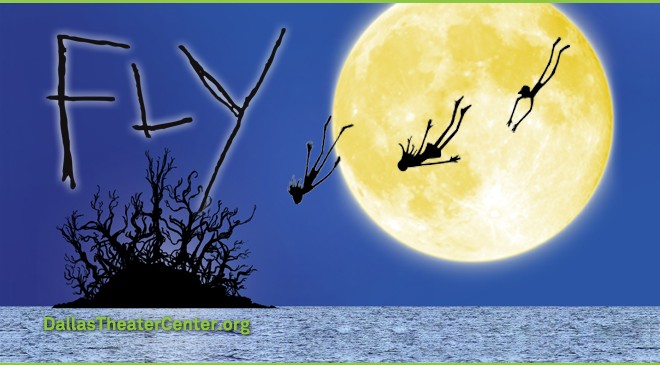
I'm sure it's unfair of me to judge Fly, the new Peter Pan musical at Dallas Theater Center, without seeing it, but I'm going to do so anyway. From what I'm reading, I'll have to remain unfair because I don't think I can stomach seeing it.

"Forget the ground, forget the sky, 'cause the more you forget the higher you will FLY! FLY, a new musical where Peter Pan flies Wendy and John on an action-packed journey to Neverland that is both fun and scary, exciting and sad. With a new sound and score by Bill Sherman, Rajiv Joseph and Kirsten Childs, FLY shines a whole new light on J.M. Barrie's classic novel...it's not just for kids anymore. For adults and kids. Recommended for age 8 years and above. Not appropriate for children under 5 years old."


\


I'm sorry, wasn't the original exciting and sad, and not just for kids? Here's how we reference the original source material while at the same time disregarding it.

From the bits I'm gleaning--this is from the producer of "Rent" and "Avenue Q," Wendy is grounded for one too many "inappropriate adventures," there are "adult women in tree costumes," pirates who resemble street people (because that's not offensive), lost boys who look like refugees from a gang way (because that's not offensive either), "short, perky tunes"by Sesame Street's music director, and a Tinker Bell with a fixation on young boys--this sounds to me like a Peter Pan nightmare. Adding hip hop isn't going to help. Most updates of the story ring false to me (as in the movie "Hook") and I don't see this being any better. It seems like something that should be doable, but I have yet to see it pulled off well.

Additionally, Lawson Taitte's review says Peter himself gets lost in the musical's psychology, and my beloved Hook seems to be no more than a personification of age hostile to youth. Ironic, since this production isn't recommended for children under eight.

I am admittedly a purist to a fault about many things, and I realize I have a tendency to take other people's Peter Pan interpretations a little too personally at this point*. But I feel better realizing I'm not not this way about all experimental productions. Houston Ballet just staged a dance version I'd have given a lot to to see.


Here's one directed by New York's Robert Wilson which recently premiered in Berlin, with music by CocoRosie, that I would see in a heartbeat and expect to love. Of course, if I were to learn that CocoRosie are originally from Neverland, I'd believe it, so that doesn't hurt.


I simply feel there's only so much surgery one can do on a thing before the heart falls out, and FLY seems to be lacking that organ now altogether.


*For what it's worth, a comment on Project Runway made me think of a Peter Pan Burning Man camp, and I think that would be awesome. Someone do that, please.

Monday, July 22, 2013

Mysteries solving themselves


Back in March, I found these at a local Value Village. $1.99 each. I tried without success to find out who the artist was, and friends who searched on my behalf came up with nothing either. (The limitations of internet search have become frustratingly apparent to me as I've progressed on my project.)

But last week, I acquired a book (Peter Pan on Stage and Screen, 1904-2010, by Bruce K. Hanson) in hopes of determining which songs entered the stage production when, for possible reference in chapter titles, and inadvertently got the answer to my mystery as well.

The book is filled with illustrations,  many of them in color. Including this one:


These are undoubtedly, to my mind, from the same family. Both this poster, from the book, and mine are for Charles Frohman productions, and as far as I can tell, they're by the same artist, Charles Buchel, for Strobridge Litho Co.I'm guessing these were all from the same 1906-07 production. I call success! This is why I am continually searching for pieces to fit together, because they don't always come from expected places.

The chances of my stumbling across those posters in a Value Village? I can't say. They're in far too good condition to be anything other than reproductions, but they certainly aren't any of the more commonly seen artistic promotions of the play. I'm quite pleased with my find, especially now that I have this new information.

Charles Frohman himself is an interesting footnote. A renowned Broadway producer, he discovered a number of American theater stars and had one of his greatest successes with his 1905 Peter Pan. One of the friends I mentioned earlier pointed me towards the story of Frohman's death: He was aboard the RMS Lusitania in 1915, within sight of the coast of Ireland, when the ship was hit by a German torpedo. With an injured leg, he couldn't manage the jump into a lifeboat, so instead he stood on deck talking to friends and smoking a cigar. Reportedly he paraphrased a line from Peter Pan as they waited for the ship to go down: "Why fear death? It is the most beautiful adventure that life gives us."


Friday, July 12, 2013

Art spotting

I have found an artist who drew Captain Hook in a red coat pre-Disney.

American illustrator Roy Best was contracted by Whitman Publishing Company in 1931 to illustrate The Peter Pan Picture Book, based on the play. This is the first portrayal of Hook in red that I have found, and I suspect it was the original inspiration for Disney's art design. Although the animated film was not released until 1953, Walt Disney began work on it in 1935, only to have production derailed by World War II.

Note also Peter in green tunic and tights, with feathered cap. Hmm.


Roy Best also illustrated "Saturday Evening Post" covers. And painted pin-up girls. Well, I have long maintained that Peter Pan is not exclusively a children's book.


Friday, June 7, 2013

From the sublime to the--well, mostly just ridiculous

This post comes to you because I was under the impression actor Terry-Thomas had played  Hook in the 50s  and I wanted to compare his picture with Dustin Hoffman's portrayal. Alas, I was misled by something on the internet (yes, I know) and evidently there is no such animal. However, I did find a surprising list of some actors who have played Hook.

Let us begin here.

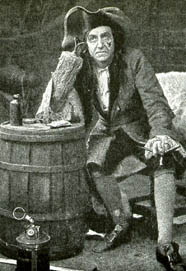
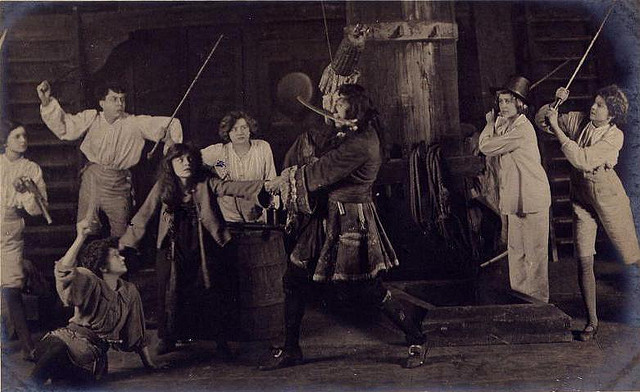
Robb Harwood, 1906


Ian McKellan, 1997

Did you enjoy the sublime? Good, because it's pretty much ridiculous in one form or another from here on out.

Russell Brand with photographer Annie Leibovitz, Disney Parks Campaign
In a way he's perfect. In all the others, he is so, so wrong.

Hans Conreid, voice of Captain Hook in the 1953 Disney movie.
In the ridiculous category because I find this costume particularly suitable for voice acting.


Larry Lamb from Eastenders, 2012

Eastenders, then. And who the heck is Dame Abel Mabel? That's not from any production I've ever seen.


But now, my piece de resistance.

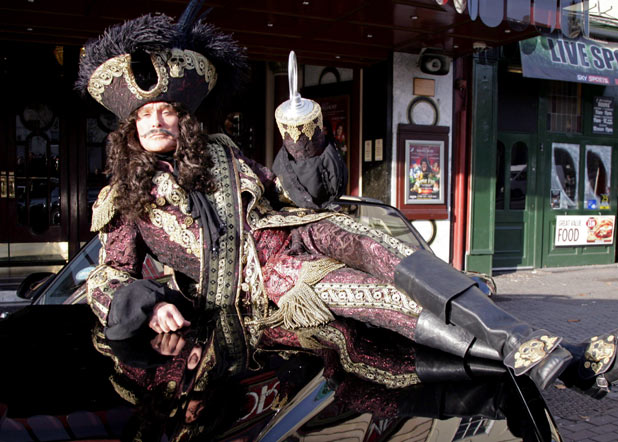
David Hasselhoff, 2012


He's pulling off the look better here, but David. Hasselhoff. I am--I don't know what I am. Bewildered will do. I am bewildered.

Friday, May 24, 2013

James Cameron vs. James Hook

I approve. Actor  Jonathan Hyde, who played Captain Hook in a 2010 California production of Peter Pan, has some insight into the character. Hyde also worked with James Cameron on Titanic, playing the part of J. Bruce Ismay, chairman and managing director of the White Star Line. When asked if he brought any of the director's temperament to the part of the Captain, he replied, "On set, Jim was fairly furious and fearless, and he served up some pretty fabulous pyrotechnics when things weren't going right. Which, I suppose, is also something Captain's Hook's nature."

His understanding of Hook may explain why he had already played the role 350 times in San Francisco and London. Of course there's more to the Captain than that, but one doesn't get to see much of it in the traditional stage performance.

This particular show must have been a bang-up production, performed in a tent in the round,with CGI, aerobatics, and puppetry. A bit Cirque de Soleil, mm? I'd give it a chance.

Interactive graphic of the Neverland tent

But the main thing, of course, is the actors, and it looks like at least of them was superlative. Look, he even has the hook on the correct hand.

Wednesday, May 8, 2013


From the original--yes, the very first--performance of Peter Pan in 1904. In this photo, Nina Boucicalt as Peter, Hilda Trevelyan asWendy, Gerald du Maurier (yes,"Rebecca" fans, those du Mauriers), and Pauline Chase as Twin #1.

Fantastic set of photos here from BruceKen on Flickr, muchly copyrighted, which makes me nervous, but these are so good they must be shared.

Other actors shown in this set are Dorothea Baird as Mrs. Darling, George Hersee as John, Winifred Geoghgan as Michael, Arthur Lupino as Nana, and George Shelton in a couple of full-length shots as an exemplary Smee. (Photos which show me it's all right to keep him as gray-haired and not feel like I'm copying Disney, since his common portrayal actually has been canon from the beginning.)

Found through pixieneverland.tumblr.com, which satisfies me with dream fodder daily.