navigation

Showing posts with label J.M. Barrie. Show all posts

Wednesday, August 23, 2017

Captain of his soul

I would hate to say that I've been so wrapped in the minutiae of Peter Pan that I've missed some obvious facts connected with it, but I did not comprehend until today that William Ernest Henley--inspiration for the character of Long John Silver and also father of the young girl who gave J. M. Barrie's Wendy Darling her first name--wrote the poem Invictus. If today weren't Henley's birthday, and if Garrison Keillor hadn't mentioned him on today's edition of The Writer's Almanac, I don't know when I might have realized this.


November 26, 1892, illustration
of Henley in Vanity Fair by artist
Leslie Ward.


Born on August 23, 1849, Henley contracted tuberculosis of the bone and had his left leg amputated below the knee when he was 20. The experience led to his poem Invictus, written in 1875 and published in 1888.

Invictus

Out of the night that covers me,
Black as the pit from pole to pole,
I thank whatever gods may be
For my unconquerable soul.

In the fell clutch of circumstance
I have not winced nor cried aloud.
Under the bludgeoning of chance
My head is bloody, but unbowed.

Beyond this place of wrath and tears
Looms but the Horror of the shade,
And yet the menace of the years
Finds, and shall find me, unafraid.

It matters not how strait the gate,
How charged with punishments the scroll,
I am the master of my fate:
I am the captain of my soul.


While it's this that Henley is most remembered for, he also lives on as the inspiration for the pirate Long John Silver in Robert Louis Stevenson's Treasure Island--and  thus all the interpretations of the character that have followed since.


2002 Disney animated feature. I may once have
attended a sci-fi convention dressed as
Captain Amelia.


"I will now make a confession: It was the sight of your maimed strength and masterfulness that begot Long John Silver ... the idea of the maimed man, ruling and dreaded by the sound, was entirely taken from you," wrote Stevenson in a letter to Henley after Treasure Island was published--a line that rather reminds one of a certain Captain James Hook.

But lest you think Henley was dour and embittered by his injury and the struggles of being recognized as a poet (he found arguably greater success during his life as a journalist, critic, and editor), he was described by Stevenson's stepson, Lloyd Osbourne, as "... a great, glowing, massive-shouldered fellow with a big red beard and a crutch; jovial, astoundingly clever, and with a laugh that rolled like music; he had an unimaginable fire and vitality; he swept one off one's feet."


William Ernest Henley died in 1903 at the age of 53, leaving behind not only several volumes of poetry and critiques but also three plays written with Robert Louis Stevenson.

And returning to Peter Pan, as always we must here at Hook's Waltz, J. M. Barrie was a friend of Stevenson and found his own inspiration in  the character of Long John Silver. And it was Henley's five-year-old daughter Margaret who may have been the inventor of the name Wendy. Sadly, Margaret died of meningitis in 1894, at the age of 6, eight years before the play Peter Pan was first performed.


Monday, April 25, 2016

Good news for collectors (sometimes)

Something I've found while researching The Stowaway is a vast and (to me, at least) surprising discrepancy in the prices of out-of-print books. Some academic volumes from the ancient days of the 1980s are so expensive I can't justify buying one for a single essay on Peter Pan. But in a much happier turn of events, books from the turn of the 19th century are often ridiculously affordable. They're sold as "used," not quite antiques, not quite archivable. And while they're not as cheap as a used Grisham novel, they're also not the price you might expect for tangible bits of history.

I continue to take advantage of the situation.


The most expensive of the books above, Volume I of The Novels, Tales and Sketches of J. M. Barrie, was $10. The others were half that or less. (Ironically, I can't read them now because I have begun channel Barrie's writing style with almost no provocation, and it begins to seep into The Stowaway, where it doesn't belong.)

 I can only conclude these books have fallen into "the Trough of No Value." Mike Johnston of The Online Photographerr has this graph in his essay on the subject:


Johnston's examples include photographic negatives, computers, and lunchboxes from the 1950s and 1960s. "One of the problems of historical preservation is that people only tend to preserve things that are valuable," he writes. "And the problem with that is that value fluctuates over time." This, of course, is difficult to predict.

He also mentions that the craftsmanship of an item can determine its fall into the Trough. And this applies to books as well, of course. A perfectly-preserved first edition of a still-popular book may cost hundreds or thousands of dollars--why I don't yet have my own first edition of Peter and Wendy. But if someone like me wants a book mainly for its contents, it's worth keeping track of the Trough.

Luckily for my own collecting, I often appreciate a book all the more if it shows signs of its lifespan and evidence that it was loved. A "Merry Christmas" message from Aunt Lizzie, 1909, has value to me which it might not to a regular book collector. (This is the same impulse that has prevented me from refinishing the table I used as the background for these book photographs. A practical nostalgia?)


If you're willing to overlook some damage and signs of age, you can find a treasure trove of books from the Edwardian era. They may be offered by some unexpected sources, and that's part of the fun. I paid under $20.00 for most of these, some of which I discovered in used or antique book stores, others which I found on eBay or from ABE Books.  If they were first editions, or in better condition, they would of course be priced higher, although I think most of them would still qualify as "affordable." But I find value in their shabbiness, in evidence they were read and maybe even loved.


My copy of the 1907 The Girl's Own Annual 

So if you're interested in books of a hundred years ago, this is a good time to buy them. There's no guarantee they'll go up in price, of course, and we can't predict the desires and contexts of future societies. But from what I've observed, and from what the Trough of No Value tells us, these affordable books aren't likely to stay that way forever.


"I must go down to the sea again"


Not  Peter Pan, but relevant to The Stowaway

These books come to us without commentary, giving us a direct look into history without the overlay of our present priorities. And of course reading books from another era is one of the best ways to learn the diction and styles of writing from the past--very useful when writing about those times. But that's a subject for another day.

Sunday, January 31, 2016

Why Peter Pan still matters

It may seem ridiculous to wonder if the story of Peter Pan is still relevant, given how thoroughly it's woven into pop culture. References to its characters are dropped into TV conversations and movie scenes and newspaper articles, used to describe personalities and psychological tendencies. Over and over, retellings of the story appear, often updated and/or "dark." Tinker Bell is the Walt Disney Studios mascot (though I'm sure she'd prefer the term "spokesfairy").

But the original story is frequently lost in the cultural shorthand. Far more people know it through the 1953 Walt Disney animated film than from the original book or even the original play. And Disney, along with the 1954 Broadway musical, took liberties with the story that did it no favors--note the songs about the Indians which are so blatantly cringe-worthy today. The retellings often take the story so far from its roots than only its outlines are left.

So why is James Matthew Barrie's original Peter Pan still important today?

Gwynedd M. Hudson, 1931

❧ Because Peter Pan has value as a work of literature, as well as a source of enduring fantasy images. It's written with style and whimsy and wit, with characters who contain both good and bad qualities. It doesn't talk down to children, but instead presents them with challenging ideas and an ending that is not altogether happy. And thus it's a book that unfolds with further meaning when read by adults, one which takes us back to a time when the possible was not so circumscribed by experience and failure, yet which doesn't altogether dismiss the realities of the world.

❧ Because we all need to grow up. This idea is watered down--if not absent altogether--in many versions of Peter Pan (Disney being perhaps the worst offender here).  But the 1911 book is rife with examples of how Peter's youth makes him heartless and negligent. And children who refuse to grow up have given us climate change and the garbage gyre and poisoned water supplies. They leave the wreckage of their relationships behind them and have no idea how to look to the future. Even Peter Pan himself has some inkling of the truth of this, when nightmares bring him to tears in his sleep.

Flora White, 1913


❧ Because other eras have something to teach us, in both positive and negative aspects. It's important to understand how people lived and thought in the not-actually-so-distant past, in order to understand what we're doing here and now.

Any work of art from the past will contain ideas and attitudes we find jarring now. I've been catching up on books written ten years ago and I'm surprised how much what is acceptable to say has changed in just that short period of time. Edwardian Scottish playwright J.M. Barrie had little reason to study the history of the American Indian when he wrote a fantasy play for children. We in the modern world have no excuse not to examine these attitudes and realize what is accurate and fair. And perhaps seeing that other eras were not all as consumer-focused and cynical as ours can show us an alternative, or at least be a comfort.

❧ Because there are women--and men--who treasure the idea of being parents, though it may not be fashionable to say so. Wendy does not have to be seen as an anti-feminist icon.

Scott Gustafson, 1991


❧ Because families still lose children, to illness or tragedy. It's not as common as it was in the past and it's rarely talked about outside of support groups and immediate families. But there are parents who ache as much for their lost ones as Mrs. Darling does. Perhaps there is some solace for them in literature like Peter Pan, especially if one knows that Barrie's own childhood was marked by the death of his older brother, and that this loss resonates throughout the book.

The enduring power of an image

❧ Because dismissing literature from the past is like refusing to listen to our grandparents. Our elders have something to teach us. Yes, some of their attitudes may seem unforgivable. But they have knowledge and experience and wisdom we should consider as well.


Saturday, September 5, 2015

Peter Pan flies to Russia

He must, or how else would there be so many beautifully illustrated Russian versions of his story? I've been lucky enough to acquire three of them, from 1971, 1993, and 2010, all showing a love of J.M. Barrie's original tale despite their variance in style.


I find the loose watercolor illustrations from this 1971 Piter Pan, by May Miturich, absolutely charming.


I don't read Cyrillic--I wish I did--but this rendition of the book characters almost makes me feel like I can. Nevertheless, my artist information on these books may well be incorrect. If any of you readers do read Cyrillic and have translations for me, I will gladly add that information to this post.


Never Neverland, as seen in the dreams of May Miturich.


A completely different interpretation, in a folk-influenced, ornamental style, was printed in 1993. The retelling is by Irina Tokmakova, with illustrations by painter Tikhonov.


The black and white illustrations are as lush and intricate as the double-page color plates.


I have a special fondness for this book with its lovely, respectful portrait of J.M. Barrie.


And editions of Peter Pan continue to be printed in Russia, such as this one from 2010 by artist Mikko.


While it doesn't entirely escape the Disney influence (I note also some possible undertones of Anne Graham Johnstone and even Mabel Lucie Attwell) and modern tendency to make Peter a bit more adolescent than he was originally written, the detail of the illustrations shows the artist's fondness for the story.


I was also very pleased to find this plate within. I'd found it online, and it's the header I use for my writing inspiration Tumblr blog (a Tumblr I keep private because unfortunately, it contains a huge number of unattributed images I don't have time to research). I'd never been able to find what book it was from, and it was delightful to find it here.


This seems like an appropriate time to ask if anyone knows where I could find a copy of Piter Pan illustrated by Maxim Mitrafanov. I've been looking for this for some time, to no avail.

Wednesday, June 17, 2015

Fairies at home

Wherever children are, there are fairies, J. M. Barrie tells us in The Little White Bird. Kensington Gardens in London is filled with them, although they hide behind railings during the day and only come out to carouse at night "after Lock-out."

As for their houses, it is no use looking for them, because they are the exact opposite of our houses. You can see our houses by day but you can't see them by dark. Well, you can see their houses by dark, but you can't see them by day, for they are the colour of night, and I never heard of anyone yet who could see night in the daytime. This does not mean that they are black, for night has its colours just as day has, but ever so much brighter. Their blues and reds and greens are like ours with a light behind them.

Not all fairy houses are so elaborate. Many are constructed from leaves and twigs, stones and feathers. And some are made with help from humans.


Kruckeberg Botanic Garden in Shoreline, Washington, USA, invites children to make fairy houses in their Enchanted Garden area. I found these there last Saturday:


I also managed to get lost in the garden repeatedly, although it's not enormous, ending up over and over at the Enchanted Garden. Leading travelers astray is, of course, a popular game among fairies.


One would expect Tinker Bell to live in just such a house. And in the videos about Pixie Hollow, where Disney tells us Tink lived prior to meeting Peter Pan, the fairies do live in similar structures, decorated with items scavenged from humans, like spoons and shoes.


By the time Tinker Bell meets Peter, she aspires to a more upscale lifestyle:

[T]here was one recess in the wall, no larger than a bird-cage, which was the private apartment of Tinker Bell. It could be shut off from the rest of the house by a tiny curtain, which Tink, who was most fastidious [particular], always kept drawn when dressing or undressing. No woman, however large, could have had a more exquisite boudoir [dressing room] and bed-chamber combined. The couch, as she always called it, was a genuine Queen Mab, with club legs; and she varied the bedspreads according to what fruit- blossom was in season. Her mirror was a Puss-in-Boots, of which there are now only three, unchipped, known to fairy dealers; the washstand was Pie-crust and reversible, the chest of drawers an authentic Charming the Sixth, and the carpet and rugs the best (the early) period of Margery and Robin. There was a chandelier from Tiddlywinks for the look of the thing, but of course she lit the residence herself. Tink was very contemptuous of the rest of the house, as indeed was perhaps inevitable, and her chamber, though beautiful, looked rather conceited, having the appearance of a nose permanently turned up.


By Anne Graham Johnstone, 1988


In The Stowaway, when Vivian Drew sees this little room, she feels a pang of sympathy for the fairy whose life is so unlike the one she desires to live--a sentiment Vivian understands. Of course she would never say this within earshot of Tink, lest she find entire strands of hair yanked mercilessly from her head. Fairies do not care for pity from humankind.


Wednesday, February 11, 2015

The Mystery of the Red Coat

A year and a half ago, I thought I had found the first instance of Captain Hook in a red coat--illustrations by American Roy Best from 1931. Before then, Hook was depicted in coats of blue and gray. Of course, since the 1957 Disney film (which went into development in 1935), he's generally depicted wearing red.

But now I've learned that British painter Gwynedd M. Hudson had the same idea as Best at around the same time. As Hudson is one of my favorite Peter Pan illustrators, I'm glad now that I decided Jas. should have not only his original blue and gray coats, but red. (Although in The Stowaway, they are reserved for battle and other important occasions.)


 James, splendid in his red coat.


I'm amused how well my characterizations of the crew align with Hudson's.

My visit to the Marchpane children's bookshop at Charing Cross in London turned out to be edifying in this regard. Not only did I get to hold a 1904 first edition Peter and Wendy (with appropriate whimpers and hopes of "someday"), the seller also had a 1931 Hudson first edition with dust jacket (those don't usually survive) which now lives at my house. That was a fantastic surprise.


I have several versions of Peter Pan that include Hudson's illustrations, reprinted in a single color. I knew from pictures I'd seen online that some of the originals were in two or three colors--but in the first edition Hudson, there are many full-color illustrations as well.


It turns out to be almost impossible to find information about Hudson online. However, Antiques Atlas has a profile that gives me far more information than I've been able to find before:

Gwynedd May Hudson, 1882-1932, was a Sussex artist, who studied at Brighton College of Art. She exhibited a painting at the Royal Academy in 1912, but is best know for her much loved illustrations of Alice in Wonderland in 1922 for Hodder & Stoughton and Peter Pan and Wendy in 1931, also for Hodder and Stoughton.

She also did a series of posters for the London Underground 1926-1929, copies of which are in the London Transport Museum. One of these lithographic posters of 'The Zoo' for the Underground achieved a price of £2,750 at Christie's in 2012.


Most sources give Hudson's date of birth as 1909. She might have been a prodigy who published Alice in Wonderland illustrations when she was thirteen,but it's unlikely she exhibited at the Royal Academy at the age of three. I'm also glad to know she didn't die at the age of 33.


Hudson seems to be best known for her Alice paintings.These are easily found reproduced online and for sale from auction houses, and even on mugs and t-shirts.

Friday, January 9, 2015

Peter at the hospital

There is no more fitting place for a Peter Pan purist to visit than London's Great Ormond Street Hospital.

The hospital has had a long association with The Boy Who Wouldn't Grow Up. In 1929, J.M. Barrie declined to sit on a fundraising committee to help it expand into the vacated Foundling Hospital adjacent--and instead donated the royalties from stage performances of Peter Pan to GOSH, funds which they receive to this day. (For more information about the copyright extension in the UK and Europe that allows the hospital the continuing right to royalty, see the GOSH website. There you'll also find additional history--and better pictures than I have here, but that can't be helped.)


"At one time Peter Pan was an invalid at the Hospital for Sick Children," Barrie said in a GOSH fundraising speech in 1930, "and it was he who put me up to the little thing I did for the hospital."

At one time, the hospital maintained a museum of Peter Pan books and memorabilia. While that museum has fallen victim to the hospital and charity's need for additional space, the collection is still available for public viewing by appointment. Of course, I could hardly visit London and not at least attempt to see the collection. 


The hospital was officially named
Great Ormond Street Hospital for Children in the 1990s,
 as it had become so closely associated with the street.

When I made my appointment, I wasn't certain if I should admit to my involvement with The Stowaway and especially this blog. But I knew I wouldn't be able to keep that to myself and didn't want to spring it upon the staff, so I gathered my courage and confessed via email. And because I did, I was able to have a splendid visit with people who understand my devotion to Mr. Barrie's tale.


The collection being kept in this room was pure
coincidence, I'm sure, but a most fortuitous one.


Christine De Poortere, Peter Pan Director, and Emily Beahan kindly allowed me to babble about my own collection and thoughts about Peter and the Captain, and let me photograph the figurines, plates, magic lantern slides, and other memorabilia that have been given to the hospital over the years. These include the bell that was Tinker Bell's voice in the original 1904 stage production of Peter Pan. And yes, I got to ring it.


The bell in the back right corner was
 used to voice the original Tinker Bell.


GOSH has more Peter Pan books than I do--
two cupboards worth.

Casts of London productions of the play still put on performances at the hospital for patients, as they have done for decades. And Peter's influence is felt throughout the halls.

Art students of the University of Wolverhampton
 created and donated this tiled mural in the late 1980s.

Peter appears where he is not expected, as is his wont.

Since it opened its doors on Valentine's Day of 1852 as the Hospital for Sick Children, GOSH has grown tremendously, expanding into many surrounding buildings in its neighborhood of Bloomsbury, where Barrie lived for a time just around the corner from the original hospital. It's part of the National Health Service, but funds raised from donations help them with redevelopment, research, medical equipment, and support services for families.

The charity staff at GOSH couldn't have been more gracious, and I'm certainly glad I was able to meet them and take the tour. Of course I'm also pleased to know they are still receiving the benefit of Barrie's donation, and putting it to the best of uses.

Thursday, December 11, 2014

Peter sings, but not always

NBC's Dec. 4, 2014, Peter Pan Live was the second in the network's present-day lineup of holiday live musical performances (the first being last year's Sound of Music)--but it's the third time the network has presented a live musical version of Peter Pan.

Tracking the musical changes in J.M. Barrie's play is as challenging as following Peter himself through the treetops of Never Neverland. Not only did the playwright himself make changes to his work for more than twenty years, only publishing its final form in 1928, some of the songs we most associate with the play came years after that. And it seems nearly every time it's staged in the U.S. for Broadway or TV, it appears with new music.


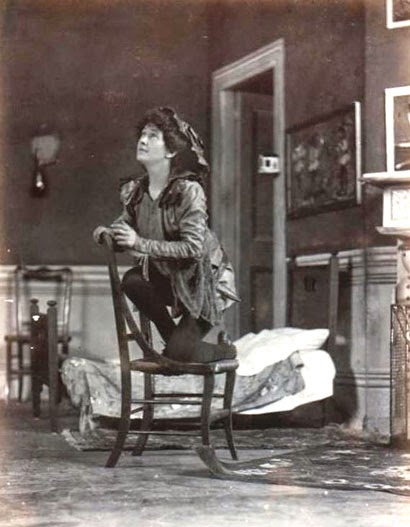
Nina Boucicault


Peter Pan premiered at the Duke of York's Theatre on December 27, 1904, with Nina Boucicault in the title role. Thus began the tradition of casting a woman as Peter. Barrie was never averse to the idea of a boy in the role, but child labor laws of the time prevented children from working in the theater at night, and women were considered more believable as boys than were grown men.

Producer Charles Frohman brought Peter Pan to America in 1905 with Maude Adams in the title role. Bookmice has some fun facts about the production, including the fact that Barrie was skeptical that the play would find success in the States--until it ran for ten years. Adams was a singer, and her Peter sings the bawdy "Sally in Our Alley" to the lost boys. And it was she who introduced the world to both the Peter Pan collar and Peter's feathered cap. Frohman often added music by new American songwriters to plays he brought from England, and in 1907 Jerome Kern and Paul West included a ditty called "Won't You Have a Little Feather" to a pillow dance scene with the lost boys.


Maude Adams


The original play featured a couple of songs--"Lullaby" and "Song of the Pirates"--and a score by John Crook (composer and conductor for Duke of York's Theatre), but it wasn't until the 1950s that Peter Pan became a full musical. Leonard Bernstein wrote music for a show produced by Peter Lawrence for the 1949-1950 Broadway season, which was scaled down to "a fantasy with music," because the actress playing Peter, Jean Arthur, didn't sing. Six songs remained, three for Wendy, two for Hook (Boris Karloff) and his pirates, and one for a mermaid duo.

Barrie biographer Roger Lancelyn Green was not impressed with the changes:
By this time the craze for musicals had fallen like a blight upon the American stage, and therefore Peter Pan  must be shorn of Crook's music; Leonard Bernstein must write a new score and interpolate five songs, while a ballet sequence must be devised for the Redskins, and the pirates become a chorus.

Nevertheless, Bernstein's Peter Pan was a hit with audiences and most critics--and was then overshadowed altogether by the Disney animated film in 1953. Bobby Driscoll played Peter, and an entirely new set of songs were written by Sammy Cahn and Sammy Fain. "What Makes the Red Man Red?" is one of the more awkward relics of its time, and is frequently replaced in current stagings like NBC's Peter Pan Live. "You Can Fly, You Can Fly, You Can Fly" and "Your Mother and Mine" are more fondly remembered.


Mary Martin and Cyril Ritchard


Mary Martin became Peter in 1954 with another Broadway staging, this one with new songs yet again. Forty-five minutes of music were added, which necessitated cutting the script itself. and Jerome Robbins came on board as director, while Johnny Richards wrote music and Carolyn Leigh lyrics for "I've Gotta Crow," "I'm Flying," and "I Won't Grow Up." But the production didn't initially fall together in a way that pleased anyone, and Jule Styne, Adolph Green, and Betty Comden were brought in to add tunes, including  "Never Never Land" and "Hook's Waltz" (and yes, that is the origin of this blog's name). Unfortunately, there was again a song, "Ugg-a-Wugg," which makes modern audiences cringe. New York Times critic Brooks Atkinson wrote that the score "has no audible fondness for Barrie," but this is the version of Peter Pan most often performed now in the U.S.


Danny Kaye and Mia Farrow


And the other two NBC productions? The first was the Mary Martin staging, still beloved today, which was broadcast live on NBC on March 7, 1955 and reprised in 1956 and 1960. And in 1976, NBC produced another version of the play as a Hallmark Hall of Fame presentation, with Mia Farrow as Peter and Danny Kaye as Hook. Another new score was written, with a few strong numbers, but the overall effect was considered lackluster and the show was not broadcast again.


A Peter Pan remembered fondly by both television and theater audiences is Cathy Rigby, who took on the role from 1990 to 2013 (with more than one farewell tour, so don't count her out yet). Her performance was broadcast by A&E in 2000, and she receiving a Distinguished Lifetime Service Award from The League of American Theatres & Producers in 2004.

And the changes continue. While Peter Pan has been adapted in the 2000s in UK as panto, which doesn't stretch it too far out of its original form, new music has also been written for other UK renditions. In 2001, Peter Pan, a Musical Adventure was performed as in the UK as a concert and then made into a stage production in 2007.


I could never have followed the trail of Peter Pan stage interpretations without Bruce K. Hanson's Peter Pan on Stage and Screen 1904-2010 for much of the information in this post. Here's his blog and review of NBC's 2014 Peter Pan Live.