navigation

Showing posts with label research. Show all posts

Friday, July 28, 2017

Peter Pan and the historical novel

The Stowaway began as a fantasy story, but it very quickly became a historical novel about Edwardian England (and other places). When I discovered the Historical Novel Society, I realized I had found a group of people who also understood the pleasures and perils of research. And when the organizers announced their 2017 conference would be held in Portland, Oregon--only a few hours' trip away from me--I knew this was something I shouldn't miss.


And sure enough, I found panels and sessions on topics immediately relevant to my work, from one on historical fiction set in and around World War I (a conflict that will inform the potential sequel to The Stowaway) to panels on Gilded Age fiction (including fairy tales set in that time period) to Victorian funeral customs  (as there is a funeral in The Stowaway).


Art in Harper's New Monthly Magazine,1880, by George du Maurier,
grandfather of the Llewelyn Davies boys who inspired
J. M. Barrie to write Peter Pan.


I also learned about new places to find primary source materials, some expensive and difficult to access for non-academics, but others free and online, such as ProfNet (set up for journalists, but helpful for other writers as well), The American Association for State and Local History, and Google Scholar --and don't forget Google Maps. The Metropolitan Museum's website Heilbrunn Timeline of Art History is particularly wonderful, both as a historical reference and for illustrations of building interiors.

Always of interest to historical fiction writers is the question of balancing history with fiction. Specific facts add realism to a novel and bring the reader deeper into that world, but too much of that can distract from the story the writer is trying to tell. Inaccuracies can throw a reader out of the story. And as was also discussed at the Pop Culture Association/American Culture Association conference I attended in Seattle last year, a historical novel is also a novel about today. Research turns up new information every day, and our interpretations of the past vary accordingly--and it's unavoidable that we bring our own contemporary values and outlook to what we write. We inevitably comment on the time we're writing in as well as the time a novel takes place, and that, along with putting the past into context with the present, makes historical fiction relevant to modern readers.


Peter Pan in Barrie's hometown of
Kirriemuir, Scotland.

The 2018 HNS conference will take place next August in J. M. Barrie's home country of Scotland. This is a little more difficult to arrange than a four-hour drive from home--but no doubt it would be worth the effort.

Tuesday, December 3, 2013

The ruination of my reading

I have always been an inveterate reader. Nothing altered that, not the passage of years or changes in my life, however substantial--until I became serious about writing. I truly believe reading is essential for good writing, but now I must devote my time to the creation of stories, and hope I did enough reading in past years to make up for the lack now.

Which is not to say I no longer read, but that I no longer grab up any book that looks like it might be interesting, or follow lists of what's new and notable. My reading now tends more and more to fall into various categories of research. (And this aside from pure research books, like guides to ship rigging or celestial navigation). Mind you, the categories are flexible, and I'm certain I'm still learning from the experts as well as enjoying filling in the information I require, but the categories of interest have certainly narrowed. Some apply more specifically than others, but all give me at least a sense of background or a flavor of a time and/or place that's relevant to The Stowaway.

On my current To Be Read list, in either paper or Kindle format (occasionally both), by the aforementioned category:

Edwardian:

  • Coral Island, J. Michael Ballantyne (an influence on J.M. Barrie)
  • The Journal of a Disappointed Man, Wilhelm Nero Pilate Barbellion (you may be relieved to know that is the nom de plume of a man actually named Bruce Frederick Cummings)
  • The Moonstone, Wilkie Collins (because I need to know if it really is likely to be Vivian's favorite book)
  • Girl of the Limberlost, Gene Stratton-Porter 


Sadly, neither my paper nor electronic copy looks
like this. Would that one of them did.


Nautical:

  • Moby-Dick, Herman Melville
  • Ahab's Wife, Sena Jeter Naslund
  • Evolution's Captain, Peter Nichols (the clash of science and religion in the era preceding and influencing the Edwardians, ships)
  • The Navigator of New York, Wayne Johnston (polar exploration and ships)
  • Master and Commander and Post Captain, by Patrick O'Brian (along with Sea of Words--at a whopping 400-plus pages--a companion glossary compiled by Dean King with John B. Hattendorf and J. Worth Estes). I have the DVD of the first novel too, and I'm planning to immerse myself in a Master and Commander weekend before too much longer.


Erich Lessing in John Huston's 1954 film of Moby-Dick. This
 would make me want to read the book if I hadn't already decided to.

England:

  • Thames: The Biography, Peter Ackroyd
  • Imagined London, Anna Quindlen


The Amazon/City of Manaus:

  • The River That God Forgot, Richard Collier
  • The Sea and the Jungle, Henry Major Tomlinson
  • The Naturalist on the River Amazon, Henry Walter Bates
  • State of Wonder, Ann Patchett


Miscellaneous

  • The Secret Life of Pronouns: What Our Words Say About Us, James W. Pennebaker (because I want to make sure I don't get James's speech wrong)


So how am I doing with all this? Well, um, I'm a third of the way through Moby-Dick and halfway through The River That God Forgot, and I've started Imagined London and Thames: A Biography. And I've read a few books that don't appear on the list. Possibly I am going to start to need to block out more designated reading time, which will include pushing those ever-present temptations of Twitter and Tumblr off to the side of the map.

Edward Gorey had the truth of it.

But lest you think I've forgone all recreational reading, I've read almost the entire Inspector Lynley series by Elizabeth George this year, thirteen volumes so far. (And some of them are long!) Of course they are set in locations around England, thereby possibly qualifying them as, er, research...

Friday, November 1, 2013

Off to Brazil

If I were to do this blog-post-a-day through November (NaBloPoMo--good grief), it would probably contain a lot of posts like this:

Using  J. M. Barrie's "Hook at Eton" speech as a source of inspiration has led me some directions I likely wouldn't have gone by on my own, most particularly to Brazil. Barrie describes an event that takes place off Manaus whichI was going to allude to only briefly in passing, until I realized about a month ago that I need a freshwater setting for piranhas--and it makes more sense in all ways to use it as the setting of a critical plot turn, thereby being far truer to both Barrie and literary consistency. My original reservations turn out to be invalid--it would take the ship only about a week to travel to Belem and then another week up the Amazon River from the Windward Islands, and events that take place aboard the ship can happen on the river just as easily as on the open sea. The additional research is, well, research. I'm up to the task. I'll stop here lest I give too much away, as I always think I'm close to doing.


 The Rio Negro meets the Amazon just west of Manaus, Brazil.

I hadn't originally intended to use "Hook at Eton" as the source material it's turning out to be, but once I'd read it, going against Barrie's history of Hook was too jarring for me to consider for long. I still maintain that he didn't get all the facts right, but of course he wouldn't have, Peter Pan being less than a reliable source and the media being what they are.

Assuming I do this--what was it? NaBloPoMo--thing, this blog will be filled with research bits about Manaus in 1908 and the Amazon River and such, no doubt written in more haste than normal, for a bit. Stick around for the excursion, if you're so inclined. I plan to continue with my normal Thursday "strange things I have discovered or considered" posts as well.

Thursday, October 17, 2013

On the trail of Tinker Bell

Tinker Bell's transformation from a spot of light dancing about a stage to the winged pin-up girl we see everywhere today is directly a result of the 1953 Disney animated film.


Tinker Bell had appeared on film before, in a 1924 version of Peter Pan.


However, when Disney artists began work on their own version, they had their own preferences for the character. Two of the principal animators at the studio wrote that story artist 'Joe Rinaldi wanted Tinker Bell to look more like the popular bathing beauties of the time," according to Murray Pomerance in Tinker Bell: The Fairy of Electricity" in Second Star to the Right: Peter Pan in the Popular Imagination. The human model for Tink was Margaret Kerry, an actress known as "The Best Legs in Hollywood" (not Marilyn Monroe, as has often been rumored). Kerry also provided the voice of the red-haired mermaid in the film. 

The pixie's fiery personality was also developed in animation--not so far from Barrie's original descriptions, in fact.

Roy Best, 1937. Tinker Bell as drawn by a pin-up artist is less of a pin-up girl than Disney's version.

As to why Barrie included a fairy in Peter Pan to begin with, reasons are numerous. Barrie's work was influenced by the folk tales of his native Scotland, and "Kensington Garden" by Thomas Tickell, written in 1722, is frequently cited as the inspiration for the setting of Barrie's entire fairy world of Kensington Park.

In 1901, Barrie and the Llewellyn David boys were enchanted by Seymour Hicks's theatrical hit Bluebell in Fairyland, which they went to see together during Christmas time.

And specifically, in Barrie's dedication "To the Five," he writes, "As our lanterns twinkled among the leaves [Michael] saw a twinkle stand still for a moment and he waved his foot gaily to it, thus creating Tink."

Special thanks to www.rarestkindofbest.com and the (sadly) largely inactive www.jmbarrie.co.uk for information used in this post.


Sunday, October 13, 2013

The wrong Jolly Roger

Whatever I may say about the accuracy of character portrayals on "Once Upon a Time," I applaud the show regularly for getting Captain Hook's ship right.

You may also recognize the Lady Washington as the Interceptor from Pirates of the Caribbean.

The producers are using the Lady Washington as their Jolly Roger (some of the filming has been done on the actual ship, the rest on a full-sized replica). And the Lady is a brig, as is the Jolly Roger, according to J.M. Barrie. You will note she has two masts. I know right away when artists haven't done their research, or have chosen to dispatch with Barrie's vision, the moment I see three masts. 


A brig has two masts, square-rigged.


I call Disney as the original instigator of this travesty.

Yes, maybe I'd like to have one of these models, but that does not mean I think this is accurate.

James Coleman, "Moonrise Over Pirate Bay," current fine art for Disney by one of its animated film landscape artists. Beautiful! But not a brig.

I suppose Disney's version has become the popular default.

Nadir Quinto, 1982


But it's hardly just Disney.

Model for the ship in the 2003 film of Peter Pan. Looks to me like a clipper, maybe, not a brig

I don't know why it's hard to get this one right. It's easy enough to do the research, and a brig is a lovely ship--it's not as though it weren't just as pretty as a clipper or a frigate, even if less imposing.

A brig! Robert Ingpen, 2004


Of course, it's not as if I'm not also confronted regularly with the placement of the Captain's hook on the incorrect hand. I just realized even one of my favorite Peter Pan artists' renditions has that issue.

Gwynedd M. Hudson,  1931. It is almost impossible to find biographical information about her online, and I was sorry to discover this may be because she died at the age of 26.  Hudson studied at the Brighton School of Art, and is also remembered for her illustrations for Alice's Adventures in Wonderland.

At least I know artists have used the play as their inspiration at least as much as the book as regards the hook, which is an element that has changed from one production (and actor) to the next. I don't think they have as good an excuse for ship inaccuracies.

Wednesday, September 18, 2013

Reasons I love research

During the Victorian era, Rowland's Macassar Oil was popular for men's hair styles. So popular, in fact, that the antimacassar was created (and named) for the purpose of keeping it off furniture.


I associate mangoes with the Caribbean, and I'm sure I'm not alone in that. But they originated in South Asia. They took so well to the climate of the Caribbean, and in fact the rest of the tropics, so long ago that they may as well be indigenous to the region (but they're not).

I am the only person on earth who doesn't like mangoes. But now my narrator doesn't either.


A two-foot-tall cat sculpture named Kaspar has been a regular dinner guest at London's Savoy Hotel since 1926, for parties that do not wish to have thirteen persons seated at their table.


James Hook has yellow blood, according to J. M. Barrie in his "Hook at Eton" speech, but he's not alone. Sea cucumbers have yellow blood too. This is due to a high concentration of a pigment called vanubin, which serves an uncertain purpose for the sea cucumber. For James too, I suppose.


Thursday, September 12, 2013

Point of pride

This is my beloved Peter Pan collection and research trove. You may notice a lean to the bookcase and a bowing of the shelves. I believe these were issues before I designated the bookcase to my research, but I may be wrong. 


The first two shelves are various editions of Peter Pan with pictures by various illustrators, with a little space left for more additions plus a few books that wandered away before I took this picture. I may be creating a collection where individual items may not be of great monetary value individually, but which is significant as a whole. I'm not the only person to do this, of course (I'm not even the only person in Seattle-- more on that later), but I can't help taking some pride in watching it grow.


On the third shelf, the books to the left are other people's takes on Peter Pan, including those prequels that vex me so. And to the right, books that are inspired by the story, scholarly analyses of the play, the book, and children's literature in general, and a few non-Peter-related works by Barrie. The remaining two shelves are additional research materials, not just for The Stowaway, although a number of them are relevant--books on English history, tall ships, and the like.

And of course there are a few collectibles scattered throughout.


There is less space left on these shelves than I realized before I set out to write this. That third shelf in particular is going to have problems soon.

Two things I have learned from this process: One, it is not worth buying furniture made out of sawdust and glue, and I resolve never to do so again. The most dilapidated bookcase from the 1930s is going to serve its purpose far longer than a facsimile from Ikea.

And pop-up books should be purchased new. Used ones will have at least one pop-up that doesn't work, no matter how well they've been cared for, which is just disappointing.


Wednesday, August 14, 2013

Not an acorn, but a button

This may well be the most controversial thing I ever write. But a purist can't let public opinion stop her from conveying the truth, can she?

Peter Pan did not give Wendy an acorn, despite the scads of interpretations that depict exactly that. According to Mr. Barrie, he gave her an acorn button, which was enough of a distinction to start me wondering. An acorn button began to seem like something so commonplace in the Edwardian era as to need no explanation, but which most of us have no knowledge of now.

And a button seemed so much reasonable to me. It's this button which Wendy puts on a chain around her neck, which saves her life when the lost boys shoot her down from the sky with an arrow on Tinker Bell's orders.  How, I wondered, would Wendy go about putting Peter's acorn on a chain around her neck? Did she pull a tiny drill out of her sewing kit and put a hole through the cap before the sound could wake her parents?

As I had only suspicions but no grounded knowledge, I set my crack team of vintage costumers (yes, it turns out I have one, and useful that turns out to be) on the trail, and sure enough:

These:


are acorn buttons. It's one of the terms for shank buttons made of wood or metal, often wrapped with decorative thread, and that fact would have been common knowledge in the era when Peter Pan was written.

So the button that stopped Tootles's arrow from killing Wendy? Was one of those, not one of these:


(The link will take you to directions to make an acorn necklace, but it requires glue and time to dry. Still not something that can be done in minutes). The confusion is understandable, and not just because of cultural changes. Peter is from the wilderness, Wendy from domestic life in the city--an exchange of acorn and thimble has thematic resonance. And he would have more access to acorns than buttons, although I'm sure he would have no problem finding the latter on the London streets.


Still. Accuracy, please! Mind you, I think trinkets like the one above are lovely, and I have a couple myself which I've been wearing even though I had that feeling they were incorrect. (The one above is from Hooligan Alley on etsy.com.) I won't blame the 1953 Disney film for the error (not this time); that film's entire exchange came to down to Wendy giving Peter a thimble because he was so alarmed by her attempt to give him an actual kiss. Wendy doesn't put anything around her neck, and Peter saves her from falling when the lost boys shoot their slingshots at her at Tinker Bell's order. As much as I love the 2003 film, it carries more blame because Peter does in fact give Wendy an actual acorn.

Thus do fairy tales change over time, although when I can look to the original for facts, I will continue to do so and wave my tiny, ineffectual banner in an effort to draw attention to them. The thimble/kiss confusion does play a part in The Stowaway. It will be easy enough to insert a bit of correction while I'm in there.

Wednesday, August 7, 2013

Skylarking

First, a man passing me on the street last week when I was on my way to a restaurant to  work on reading Midnight in Neverland. "The main character is a British Navy captain," he was saying to his friend. 

"What?" I thought. "I mean, yes, he is, but--huh?"

Second, The Peter Pan Alphabet, written and illustrated by Oliver Herford, from 1907. (So, based on Peter Pan the play, not the book.) It's sardonically beautiful and quite short, and you can read it for free from Project Gutenberg at the above link. Caveats, though, on references to the Indians (I know it was the times, but ouch) and Hook/crocodile art. Fine, maybe that last warning is just for me. 

I love this. It's referring to a scene where Hook, in battle with Peter, tries to blow up his ship, only to be foiled when Peter puts out the fuse. (The Stowaway may or may not have its own take on this.) It's also proof that the more things change...


I’m sorry for H, tho’ I don’t call Hook mean
For wanting to Blow Up his own Magazine.
I’ve known a Good Author blow up, in a Huff,
A Magazine just for not printing his Stuff.


Oh, why not one more:


Z is the Zebra the Boys didn’t meet,
But without which no Alphabet’s really complete.

Thursday, August 1, 2013

Finding my way

This beauty is a 9" brass sextant, which I just bought for the purpose of teaching myself celestial navigation, because my narrator can't learn navigation if I don't. Mind you, Vivian ends up better at it than I'll ever be, and does it faster, but I need to know what she's talking about.


The fact that it's also handsome decor is a bonus.


The sextant goes along with the book and the DVD and the diagrams and a couple of downloads. Unfortunately, the sextant is heavy enough that I won't be hauling it around me everywhere--the printed or online materials will have to do some days. I don't need much more than a rough idea of how to do this, really, and I don't plan to volunteer my navigational services on anyone's ship any time soon. I just need to know what I'm talking about, and presumably all this will provide enough basics for me to do so.


I have the impression writers are prone to developing odd hobbies. Collecting odd decor too, perhaps. Thank goodness nautical props and art and instruments are pretty.

Wednesday, July 3, 2013

Keeping faith

Retellings are part of the tradition of fairy tales and one of my favorite literary forms. Most of these, of course, are tales that originated so long ago we have no idea of their beginnings, although we may know their more familiar interpreters, and that provides a certain amount of latitude when deciding how to represent the story.

"Peter Pan"is a challenge for me in this regard, as we do have the original text of the original story in both J.M. Barrie's 1904 play, and in his 1911 book, but there are ways in which they disagree. The play itself went through numerous revisions during its first years. And then there are the multitudinous interpretations of both, some of which are better known than the originals, including the inescapable (trust me on this) Disney film which has become an overlay over nearly every Peter Pan retelling since its release in 1953. So many iconic representations that don't agree with the original, and here am I, trying to be true to the original without disregarding other interpretations or inadvertently stealing from them.

Our boys as most of the world now pictures them, courtesy of Disney Studios. (|Yes, that is commentary as well as an accurate credit.)


But it was not always thus. Behold, Peter Pan in red. And Captain Hook in blue. This is by Alice Woodward, from a 1907 novelization of the play by Daniel O'Connell. (And off to ABE Books your blogger went, having just discovered today that this book exists. Yes, there are affordable copies, and I can't wait to get that full set of pictures.)


Here we have an illustration by Flora White  from 1914, after the initial publication of "Peter and Wendy" in 1911. Possibly the skeleton leaves that Barrie describes Peter as wearing, but again he's in red.


Barrie himself chose Mabel Lucie Attwell to illustrate the gift book version of "Peter Pan" in 1921. Still not the green tunic and tights most people picture Peter wearing**. I'm also struck by how young he looks, unlike most versions since.


The first version I can find of Captain Hook in red is 1931, Gwynedd Hudson's illustrations.


 Although I wonder if this was colored in after 1953, because I have two books with versions of his art (hush), and in one, all the pictures are brown on white, and in the other, the colored plates appear as so:


Disney made the red coat iconic, and it's not until the 2000s that I find any new art with Hook wearing any color besides red. Without the red coat, the central metaphor falls right out of Peter Pan in Scarlet*. I want to think this is enough reason to keep the red coat. But mostly, I like James in red, even if Disney has earned  enough of my ire for distorting the original story that I try to avoid reference to that version altogether (not just for copyright reasons, although they would be enough). I make a nod to the original portrayals of Hook's garment toward the end of "The Stowaway," but James will wear his red coats (yes, they are plural) throughout the story.

And hence my little ballet of being as faithful as I can to the original, plus respecting what's come to be tradition, while trying to keep track of dozens of interpretations over the last 102 years.

*The only authorized sequel to the original, by Geraldine McCaughrean, winner of a 2004 contest sponsored by Great Ormond Street Hospital, to which Barrie willed all proceeds from his book.

**Where would Peter get green tights, anyway? The question answered itself as soon as I'd thought of it--he'd steal them from nurseries, of course.


Wednesday, June 26, 2013

And a star to steer her by


When I went looking for a tall ship where I could do some hands-on research for The Stowaway, I was lucky to discover that not only do we have the Lady Washington berthed not far from Seattle, she's a brig, the same type of ship sailed by Hook in the original Peter Pan.

She's also the same ship filmed by "Once Upon a Time" as the Jolly Roger. As some of you know, the battle sail my husband and I were originally scheduled to sail on was postponed a week because the show's taping ran long. I had no idea about any of this until I was standing on the deck of the ship--one of the weirder examples of the weird that follows this project. Don't even start me on OUaT Hook's true love being named Milah, because I still don't quite believe I heard that right.

As many things as Once Upon a Time gets wrong (some of you have seen my rants on the subject, ahem), they got this one right, which is unlike far too many depictions of the Jolly Roger. I've begun  doing a cursory count of masts whenever I see one of those depictions, because as much as I like some of the incorrect art, it's really not that hard to get it right.


Robert Ingpen gets it right. His Peter Pan illustrations are beautiful in general, but he won me over completely with this.

Thursday, June 20, 2013

Slouching towards Eton

Even without the existence of "Hook at Eton," it would be easy enough to know the Captain's school affiliation merely because "he still adhered in his walk to the school's distinguished slouch." I find no mention of the slouch in current discussions of Eton, but in the Edwardian era it seems to have been a standard association with the school. J.M. Barrie attended Eton, as did the Llewellyn Davies boys around whom the stories of Peter Pan first cohered, so the slouch would have been common knowledge among them. Of course, I do not share that history, but neither does Vivian Drew, and so we can look through the window from the outside and shake our heads together in perplexity.

In Orwell: A Life, D.J. Taylor describes a first encounter with the slouch by George Orwell's close friend Anthony Powell: "Staring out of his study window a day or two after his arrival, Powell observed a boy of about fifteen coming along the far side of the street. One hand was in his pocket. The other supported a pile of books against his thigh. The boy's top hat--these were de rigeur until the 1940s--pushed to the back of his head, was no less startling than his exceptionally short trouser legs and light-colored socks. One of his shoulders was higher than the other. This, together with a slight sag at the knees, produced a perfect specimen of what was known as the 'Eton Slouch.'"


I picture the poor Captain, after years of carefully preserving a posture that is one of last relics of his upbringing, suddenly learning that to his crew it simply appears that he is compensating for an injury--a fact he learns only when Vivian asks with concern if his shoulder pains him. (This also explains why he wears ridiculous socks. Somehow I knew he did.)

Might the Monty Python Ministry of Silly Walks sketch have been born as a parody of the Slouch? A friend and I have our suspicions. I haven't found any direct evidence, but Graham Chapman did attend Eton, and all the members attended either Oxford or Cambridge.*

George Orwell was ambivalent throughout his life about his scholarship presence at Eton, but it was not entirely unsuited to him. Taylor describes the school as "..a highly unusual place: a magisterial collective entity full of secret obscure fiefdoms; unfailingly orthodox in its make-up but quietly sympathetic to more maverick elements"--a perfect place, in other words, for the boy who would become James Hook.

Add to that Taylor's description of the boys in Pop, the elite self-elected Eton Society made up of around twenty-eight students of whom Hook was one, "who acted as prefects and possessed certain privileges, usually in the field of recherche' dress styles." Recherche': Sought out with care, arcane, of studied refinement or elegance--yes, dressing like Charles II fits those attributes nicely.

*The BBC (October 20, 2012) reports that a third of the UK's "leading people" went to Oxford or Cambridge and Eton alone educated about 4% of the nation's elite. That group is chock-a-block** with lawyers and diplomats. James has reason to feel that he's let down the side, and Vivian even more reason to resent the system altogether.

After that statistic, we all need some "Eton Rifles" by The Jam.


**A nautical term. Of course it is. (Used of a ship's hoisting tackle: Drawn so close as to have the blocks touching.)


Friday, June 14, 2013

"Hook at Eton"

Ah, Eton College.

Such a key part of James Hook's past and in fact, his entire psychology. This can be gleaned from the pages of Peter Pan, but J.M. Barrie didn't fill in many of the details until 1927, when he gave a speech at the school after being invited by the provost to refute the statement, "James Hook, the pirate captain,was a great Etonian, but not a good one."

Without this additional information from Barrie's "Hook at Eton," I would not know about James's yellow blood, or the shipwreck in Manaus. That he was a member of Pop, the nickname of the exclusive Eton Society. That he had not only held the school close in memory but had gone back to visit in later years. That he favored the poets of the Lake School, such as Samuel Taylor Coleridge and William Wordsmouth. Why a silk hat would be of such importance to him.

Vivian Drew has her own opinions about the Captain's Eton days. Public schooling goes against her ideas of how children ought to be raised, but she also harbors resentments because her gender and financial position prevented her from having such options. But beyond that, she objects to James holding those memories so close. She believes they provide constant re-injury rather than solace and prevent him from being able to look forward. Oh, how she dislikes that Eton crest tattoo of his, not that she would ever wound him by saying so aloud.


Without a December 2010 article by Brian Till for The Atlantic,  The Secret History of Captain Hook," I might be missing an absolutely key piece of research for The Stowaway. Till's article (recommended reading: it's excellent) led me to the original speech from M'Connache and J.M.B: Speeches, published by Hugh Walpole in 1939. I was lucky enough to find it on books.google.com before it was pulled down, and to get a copy for myself through Questia. It's not an easy speech to find.

I suspect that Renae De Liz has come upon it as well, from hints she has dropped regarding her upcoming graphic novel of Peter Pan, a retelling faithful to the original. (I learned just recently that this will be available primarily to Kickstarter supporters. While I'm pleased to be one of them, I'm sorry this won't be more widely available, both on its own merits and because the original Peter Pan is not as well known as it ought to be.) I hope there are more of us familiar with "Hook at Eton" than I'm aware of. The Captain deserves to have this part of his story better known.

More soon on the "Eton slouch," and also George Orwell.


Wednesday, June 5, 2013

Research win (or is that grin?)

This has been sitting on the "to do" pile for a while, and I am deeply relieved the conundrum has been resolved as well as it seems to have been.

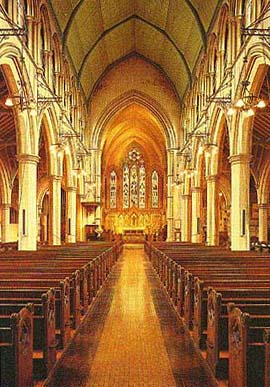
I needed a church and a swanky address a long walk's distance apart. And here we have St. Mary Abbots,


which looks exactly inside as I'd wanted it to


and is a 40-minute walk from Mayfair,


where Vivian realizes she may not prefer posh city living, adjoining "secret gardens" notwithstanding, to the crumbling family estate. In fact, that walk could easily take an hour if one were to dawdle on the Serpentine Bridge between Kensington and Hyde Parks, allowing other mourners to reach the funeral reception well before the protagonists do.

I like the idea of including the bridge, as the Serpentine Swimming Club awards the Peter Pan Cup to the winner of a 100-yard race every Christmas morning. The race has been held since 1864, and the original prize was a gold medal, but in 1904--the year "Peter Pan" made its theatrical appearance--our friend Mr. Barrie inaugurated the award that is still presented today. Admittedly, anything that takes place in Kensington Park is likely to be related to Peter Pan, but it's still fun.


Thursday, May 30, 2013

Bon Scott as psychopomp?

Hermes accompanies Myrrhine to Hades, ca 430-420 BCE, National Archaeological Museum of Athens

At first Mrs. Darling did not know, but after thinking back into her childhood she just remembered a Peter Pan who was said to live with the fairies. There were odd stories about him; as that when children died he went part of the way with them, so that they should not be frightened.

Peter Pan, according to J. M Barrie, was a psychopomp. In religion or mythology, a psychompomp guides souls into the afterlife, and in Jungian psychology, a psychopomp travels between the conscious and the unconscious--as perfect a role for Peter Pan as any I've heard.

At the risk of revealing too much of the workings behind the curtain--but not a real plot point, at least--I envision Peter returning to Neverland wearing James's cut-down black velvet funeral coat, bringing with him two new lost boys. One is named Birch, after the tree that in Celtic mythology (an influence on Barrie's writing) symbolized renewal and rebirth, traditionally used as a material for baby cradles.

The other lost boy is named Thrums after the fictional name Barrie gave to his hometown of Killiemurrie in Scotland in some of his early writings. Because how perfect a name is that for a lost boy, to go along with Tootles and Nibs and Slightly?

Kirriemuir is in the burgh of Angus, which is a great name but one with too many cultural associations to use as the name of a lost boy: Black Angus beef. Angus Young of the band AC/DC, which I never cared for due to the vocals of lead singer Bon Scott. Er, Bon Scott, who spent the first six years of his life in Kirriemuir. There's a plaque there commemorating his life, and of course there is also a statue of Peter Pan.

Dizzy yet?


Tuesday, April 30, 2013

Callooh! Callay! I have just discovered a biography of George Orwell that goes into detail about his experiences at, and opinions of, Eton--James Hook's great boyhood influence. And there was a $5.77 copy of the book on eBay from Goodwill right here in Seattle.

Some days it's so easy it's near miraculous.

Monday, April 29, 2013


This arrived today, from ABE Books through a store called Turgid Tomes. I gather they sell academic volumes and have a sense of humor about it, for which I love them with all my heart.

The book contains fourteen essays about various aspects of "Peter Pan," which I hope will provide me with some useful context for what I'm writing. Perhaps even enough context to convince me that Once Upon a Time will not steal all my potential readers or convince them to point and jeer and accuse me of Doing It Wrong.