navigation

Showing posts with label Interpretations. Show all posts

Thursday, March 20, 2014

Taking on Tiger Lily

With the casting of Rooney Mara as Tiger Lily in the upcoming Pan movie (as if I didn't have enough issues with that already, starting with the fact that it's inexplicably set in WWII), I can't not address the problematic portrayal of the character and how I hope to address it.

Anna Mae Wong as Tiger Lily with Betty Bronson'
 Peter Pan in the 1924 silent film.

Complaints about Mara's casting center around the white-washing of Tiger Lily, which has been a problem with the casting since the story was first filmed. (That said, Q'orianka Kilcher, having already played Pocahontas and Aaya in SyFy's Neverland, might want to play someone besides an iconic Indian princess for a change.)

Rooney  Mara

J. M. Barrie himself,I'm sorry to say, made no real stab at accuracy when he wrote his Indian characters to appeal to young boys in Edwardian England. 

On the trail of the pirates, stealing noiselessly down the war-path, which is not visible to inexperienced eyes, come the redskins, every one of them with his eyes peeled. They carry tomahawks and knives, and their naked bodies gleam with paint and oil. Strung around them are scalps, of boys as well as pirates, for these are the Piccaninny tribe, and not to be confused with the softer-hearted Delawares or the Hurons...

Bringing up the rear, the place of greatest danger, comes Tiger Lily, proudly erect, a princess in her own right. She is the most beautiful of dusky Dianas and the belle of the Piccaninnies, coquettish, cold and amorous by turns; there is not a brave who would not have the wayward thing to wife, but she staves off the altar with a hatchet. 

The single worst section in the book, to my mind:

They called Peter the Great White Father, prostrating themselves before him; and he liked this tremendously, so that it was not really good for him. 

"The great white father," he would say to them in a very lordly manner, as they grovelled at his feet, "is glad to see the Piccaninny warriors protecting his wigwam from the pirates."

"Me Tiger Lily," that lovely creature would reply. "Peter Pan save me, me his velly nice friend. Me no let pirates hurt him."

She was far too pretty to cringe in this way, but Peter thought it his due, and he would answer condescendingly, "It is good. Peter Pan has spoken."

I didn't even want to include this, but it's the elephant
in the living room of Neverland.

Barrie at least made Tiger Lily a warrior and foil to Wendy's domestic aspirations. The 1953 Disney film was pretty much entirely offensive in its depiction of the Indiands--it's as if the writers were not even writing about human beings. "What Makes the Red Man Red?" indeed.

(And yet my personal favorite rendition of Tiger Lily comes from a Disney "My Side of the Story" book, in which she's a real estate agent who gets in over her head when trying to find a property for Hook to buy.)


Given that I'm generally so concerned with being true to J.M. Barrie's original story, it's valid to ask how I'm addressing the portrayal of the Indians. It's a problem without a good solution. As I see it, these characters have never been done right (I think SyFy's Neverland miniseries came the closest, but I realize there are issues there as well, no doubt many I haven't even caught). The premise of The Stowaway is that Peter Pan told his story to Mr. Barrie with a plethora of wish fulfillment fantasies and misunderstandings--if not outright lies. And that includes his descriptions of the other people who live on the island.

After reading many bloggers' opinion, I went with the approach that since this tale is fantasy already, why not use a lost civilization as the "tribe" in Neverland? Research turned up the City of Caesars: a civilization founded in Patagonia by shipwrecked Spaniards who built a city of gold and diamonds. Spanish doubloons and sailors. Aha! 


As Hook says to his companion Vivian in The Stowaway,
"[The Trapalanda] are neither of Asia nor the Americas. Peter calls them Indians because he has nothing else in his vernacular that fits...Have you heard of the City of Caesars or the Wandering Town? It's a lost civilization, like Atlantis, except that here it is very much found."

I realize this approach can be seen as erasing the Indians altogether, as the movie Hook did. Tiger Lily is one of the few well-known Indian characters in literature, after all. But I would rather be guilty of that than adding to inaccurate and offensive stereotypes that I am not informed enough to avoid. I am not qualified to write an Indian tribe with the accuracy and respect it demands, nor do I believe research would be adequate to resolve my ignorance. As I said, it's a problem with no good solution. I am making this decision because it seems likely to cause the least harm.

Thursday, February 27, 2014

Ten facts about Captain Hook

As promised! More Captain Hook in the blog this year. (Such a burden.) Some of these details were previously chronicled by J.M. Barrie, while others have been revealed as I work on The Stowaway. (Sources at the end.)

1. Peter Pan has convinced himself that he cut off the hand of Captain Jas. Hook and threw it to the Neverland crocodile. [1] The truth, however, is more complicated and sadder, and took place long before the two met. [3]

2. Books from the Eton library, inscribed with the name "Jacobus Hook," can still occasionally be found in second-hand bookstores. [2]


3. James Hook does fear the crocodile, but no more than he would any large and deadly creature. [3]


4. His hatred of Peter Pan results from the boy killing his men without remorse, tormenting him ceaselessly, and being irrepressibly cocky. [1,3]


5. James Hook is an inveterate clothes horse. The red coats for which he has become known are his battle coats, and the time of The Stowaway, he has three. For regular seafaring, he wears blue or gray. [3]

6. He has patterned his appearance after King Charles II, most spectacularly in the long black ringlets in which he wears his hair. [1] While many artists--mostly post-Disney--depict him in stockings and knee-breeches, he learned early on that such dress was not practical for piracy. [3]


7. Hook's eyes are the blue of forget-me-nots. [1] Barrie describes him as "blackavized" [1], or swarthy. Perhaps this coloration can be traced to his Welsh ancestry. [3]


8. His black hair comes from his mother's side of the family, while the chin he near-despises is a legacy from his thoroughly-despised father [3].


9. James Hook was a (largely unwilling) boy soprano. [3] He also played flute [2] and harpsichord. [1]

10. The Captain detests fiction, feeling that he gets enough make-believe during the time he spends in Neverland. Rather, he prefers histories for the understand they give him of the larger world. [3]


Bonus: The ship the Captain sails at the time of Peter Pan and The Stowaway is the third incarnation of the Jolly Roger. [3]


Sources:
[1] Peter Pan, J.M. Barrie, 1911
[2] "Hook at Eton," speech given by J. M. Barrie in 1927
[3] The Stowaway, by your blogger, still in progress

Wednesday, November 27, 2013

What keeps a retelling true?

I love classic story and fairy tale retellings as a category. (Given that I write them, I would hope so.) Jane Yolen and Robin McKinley and even James Thurber give wonderful new shadings to well-known stories and bring forward themes and characters with dimension and creativity that show me new meanings in familiar things.


Lost boys, "Once Upon a Time" style. What are you doing, Disney? What?

But reading books like Peter and the Starcatchers and Midnight in Neverland, and watching shows like my favorite scapegoat "Once Upon a Time" has given me cause to examine what I like and what I object to in retellings of classic stories. (Admittedly, OUaT has thrown the original Peter Pan so far out the window that I've started enjoying the show again.)

At first, I thought I don't mind someone reworking the story if the characters are true to the originals. But that leaves out how much I love the Wicked series, and how much Gregory Maguire's characters diverge from L. Frank Baum's, making it a new narrative but one I can embrace.


So then I thought maybe I require either the plot or the character to be true to the original. But ultimately I decided what it comes down to, for me, is respect. If a retelling shows respect for the vision as it was initially created, I can appreciate it even if there are aspects I don't agree with or don't enjoy. But without respect, an author might as well create new characters. Maybe it would make it harder for him or her to get their book published, but I think that says something in itself.

Knowing the source material shows respect. Even when the OUaT writers drive me bats, I can tell there's some real knowledge of Barrie's original as well as Walt Disney's film among the writing staff. Half-done research doesn't show respect. And if one truly loves a work, it's generally clear whether a plot departure is an intentional departure or is a merely half-understood aspect plucked from the original. And I don't have time for that, or respect of my own for the retelling.

I suspect there's more here to be mined, but for now, I leave you with another problem in fairy tale retellings--the temptation to fall back on tropes, even new ones, rather than explore new ideas. Cracked.com has taken note of a few of those in fairy tale movies.

Tuesday, November 19, 2013

Defending the Captain

Sort of a Part II to this post from last Friday, although I suppose technically it may be Part III or IV by now. Regardless. Onward!

Even if I were less of a purist about Peter Pan, there was no way I could appreciate the "Peter and the Starcatchers" book after its description of Hook, who at the time of the book is known as Black Stache.  And even if I weren't so deeply immersed in the world of James Hook as originated by J. M. Barrie for my work on The Stowaway, I would be insulted by the recasting of this character I have been fascinated by for so long.

And to think I was offended that the Disney film made Captain Hook comedic and inept. I have yet to figure out why he would have his desk outside on the ship's deck.

The Stache of the Barry/Pearson books is depicted as repellent and pathetic, and he is made a figure of mockery until I feel like I'm watching school kids bullying the child who comes to school with dirty clothes and poor social skills. I end up thinking I may be glad I didn't grow up with Dave Barry (which is disappointing, as I read his columns happily for years) and Ridley Pearson, which is not a pleasant way to feel about the authors of a book one is reading.

This captain's crew call him Rat Breath. He eats raw meat from the depths of his hideously filthy cabin. He feels pride in nothing but his foot-wide moustache.
"He was a strikingly unpleasant figure, with a pock-marked face and a large red nose, like a prize turnip, glued to his face. His long black hair, greasy from years without washing, stained the shoulders of the red uniform coat he'd stolen from a Navy sailor on the high seas..." 


Black 'Stache from Peter and the Starcatchers, by Greg Call, 2004


James Hook was never like this, not even in the very first productions of the play.


Robb Harwood, 1906 play production. Note the Charles II hair. Also, no moustache.

Gone are the original Hook's Eton origin, elegant bearing, and presumably tragic past. He is no longer even allowed his original appearance. As J. M. Barrie describes him:
"In person he was cadaverous and blackavized [dark faced], and his hair was dressed in long curls, which at a little distance looked like black candles, and gave a singularly threatening expression to his handsome countenance. His eyes were of the blue of the forget-me-not, and of a profound melancholy, save when he was plunging his hook into you, at which time two red spots appeared in them and lit them up horribly....He was never more sinister than when he was most polite, which is probably the truest test of breeding; and the elegance of his diction, even when he was swearing, no less than the distinction of his demeanour, showed him one of a different cast from his crew."


Flora White, 1921

Or for that matter,  the descriptiong given by "Old Etonian Mr. G.F.T. Jasparin":
 "I do not merely mean that Etonian was written all over him; there was something even more than that, as if (may I venture) he was two Etonians rolled by the magnanimous Gods into one. In a word the handsomest man I have ever seen, though, at the same time, perhaps slightly disgusting." ("Hook at Eton," 1927 speech by Sir J.M. Barrie)

I can work with this (and I do). Even with the "slightly disgusting" part, because opinions vary.

The elegant, compelling Hook, in this case as drawn by Maxim Mitrafanov. If you see a copy of this book for sale anywhere, be a dear and let me know. I've been looking for this one for months.

Really, for Disney books, this depiction has little to do with the Disney Villain version of Hook. The play version of Black 'Stache, at least, could segue into the Captain Hook of the 1953 Disney animated film without too much of a stretch.

John Sanders as 'Stache with Joey deBettencourt as Boy

But not the Black 'Stache of the books, who just makes me sad.

Tuesday, November 12, 2013

Oh, ambivalence

So apparently Warner Bros. is planning a new Peter Pan movie . In talks with the studio is Joe Wright, the director behind Atonement, The Soloist, and Hanna, and who directed Keira  Knightley in Pride and Prejudice and Anna Karenina.

Good director, yes...but I have to agree with the critics who think it may be too soon to do this again after the 2003 adaptation, which got so much of it right. Still, this film wouldn't be finished for several years, and after all the dark Peter Pan adaptations (I include you, "Once Upon a Time"), a portrayal of the original Peter might be welcome.


And I'm unnerved at the thought of the casting. I have yet to think of an actor I would cast as Captain Hook, so I'm prepared to be disappointed already.

Of course I can't think about any of these without wondering how they might affect receipt of The Stowaway (realizing, of course, all that must take place first to get it into people's hands to begin with). There's part of me that that thinks every departure from the original will make people less likely to accept my retelling of Barrie's work. And part of me that worries the entire world will be burned out on Peter Pan altogether before The Stowaway is even in finished form. And yet there's the small hopeful voice I usually try to keep squashed says that retelling the original will make readers more receptive to my version, because they'll have the background that makes it all the more relevant.

It's best not to think about any of this too much, I generally decide, which is hard to do when I feel like I have to keep up with all of these developments so I don't accidentally crib from anyone else's work. Really, you're glad you don't live inside my head.

Thursday, November 7, 2013

Uncharted


The Neverland map we're familiar with was not drawn by J. M. Barrie, but rather Walt Disney studios and many artists thereafter. There's no map in the original book, and given Barrie's description of Neverland, it's no wonder.

"...the Neverland is always more or less an island, with astonishing splashes of colour here and there, and coral reefs and rakish-looking craft in the offing, and savages and lonely lairs, and gnomes who are mostly tailors, and caves through which a river runs, and princes with six elder brothers, and a hut fast going to decay, and one very small old lady with a hooked nose. It would be an easy map if that were all, but there is also first day at school, religion, fathers, the round pond, needle-work, murders, hangings, verbs that take the dative, chocolate pudding day, getting into braces, say ninety-nine, three-pence for pulling out your tooth yourself, and so on, and either these are part of the island or they are another map showing through, and it is all rather confusing, especially as nothing will stand still.

Of course the Neverlands vary a good deal. John's, for instance, had a lagoon with flamingoes flying over it at which John was shooting, while Michael, who was very small, had a flamingo with lagoons flying over it. ...on the whole the Neverlands have a family resemblance, and if they stood still in a row you could say of them that they have each other's nose, and so forth......Of all delectable islands the Neverland is the snuggest and most compact, not large and sprawly, you know, with tedious distances between one adventure and another, but nicely crammed."


The only locations Barrie mentions specifically in Peter Pan are the Neverwood, Mermaid Lagoon, and Marooner's Rock. So some of the locations we think of now as part of Neverland--Skull Rock, Cannibal Cove, Crocodile Creek--are Disney creations. This sent me off to do a bit of fact-checking when I first began The Stowaway so I wouldn't inadvertently crib from Disney. Now it's a handy reference point for me as to whether artists and writers are using Barrie or Disney as their starting point.

According to KStirling, contributor to the jmbarrie.co.uk message board (now mostly inactive, which is unfortunate for my research), a scenario Barrie wrote for a proposed silent film of his book was reprinted in a book called Fifty Years of Peter Pan by Roger Lancelyn Green. (I've found copies of the book online, but haven't committed yet to spending what it would cost to have one.) In his screenplay, Barrie wrote:

"We see the island all glorious and peaceful in a warm sun. We see the whole of it as in a map, not a modern map but the old-fashioned kind with quaintly exaggerated details. I have a map of the Never, Never Land, in this style which should be reproduced." The Beinecke Library at Yale has Barrie's actual film typescript, but I haven't been able to find out if it contains the map.

Wikipedia tells me users of Colgate-Palmolive's "Peter Pan Beauty Bar with Chlorophyll" received a copy of this promo map for the Disney film by sending in three wrappers with fifteen cents. I want one.

So, as it stands, the only maps of Neverland are from the Walt Disney film or are based on it. In The Stowaway, the Captain has a map of the island on his wall, useful as he makes excursions to and from and around it--but I make no claims as to the map's veracity, or how often its features may change.

Ultimately, I suppose the best description of Neverland's location is from Herman Melville's Moby-Dick: "It is not down on any map: true places never are."


Tuesday, November 5, 2013

Starcatcher vs. Starcatchers

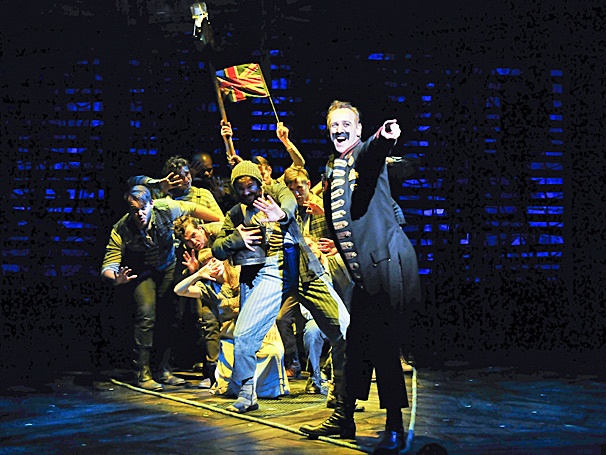
I almost avoided the play because I don't care much for the book it's based on--but I'm glad I didn't let that keep me away in the end. I thoroughly enjoyed the production I saw at the Moore Theater in Seattle on Saturday, and there were a number of ways in which I thought it improved on the book.

For one, it benefited greatly from compressing the exposition-heavy plot of the book, streamlining the original antics of three groups of sailors chasing each other's ships and each other along the high seas and around an island. The simplification made the action cleaner and easier to follow, and condensing the cast of characters allowed more development in the ones who remain. Peter, in particular, traveled an arc far from that of the natural leader he is in the books, with more emotional resonance. And parts of the book that annoyed me for various reasons were easier to take when handled briefly and with the sense of fun the cast brought to the show.


The theatrical production.especially benefits from the revision of  Black Stache--the future Captain Hook--a confident and flamboyant pirate who brings his fate upon himself and faces it with aplomb. He's not Barrie's Hook, but neither is he the Black Stache of the book, who had none of the elegance and education of the original Captain, and whose depiction I honestly don't enjoy. Instead he is his own character, and as such I could appreciate the role on its own merits, adding to rather than detracting from the play. Also, I liked the performance by the actor at the Moore, John Sanders, even more than what I've seen of Tony-winner Christian Borle's performance, because Sanders added a touch of Groucho Marx to the character that I found delicious.

Starcatcher the play also makes more clever references to the Peter Pans of Barrie and Disney, and makes the whole more of a recognizable prequel. I realize that's not what most audience members may be there for, but the passing allusions and wordplay made me think the playwright cared as much about the original source as I do. Aside fromthat, the stagecraft, especially the clever use of simple props, and the few songs there are (why are there not more songs?  she cried) helped make this a show I enjoyed far more than I expected to.

My quibbles with the books, I'll save for another post. There are lots of those left to come this month, after all.

Thursday, October 24, 2013

Okay to be in Neverland

I had thought I was reasonably well-versed in professional productions of J. M. Barrie's famous play, so it was a real surprise to discover that Leonard Bernstein wrote the songs for a rarely-performed production of Peter Pan, starring Boris Karloff as Captain Hook and Jean Arthur as Peter.


Wendy was played by Marcia Henderson, an actress who had been encouraged to pursue a stage career by writer Sinclair Lewis. The show premiered April 24, 1950, starred Boris Karloff as Hook and Jean Arthur as Peter, and was a success at the time. But it was swiftly eclipsed by the 1954 Broadway Peter Pan with Mary Martin and Cyril Ritchard, the 1953 Disney film, and Bernstein's own works, including of course West Side Story. The fact that the production included songs only for Hook, Wendy, two mermaids, and a pirate chorus probably didn't help.


"Invited to provide only a few dances and incidental cues, [Bernstein] found himself 'losing his head' and surprised the producers by writing seven songs as well, including original lyrics," writes Garth Edwin Sunderland in Prelude, Fugue & Riffs, a publication of the Leonard Bernstein Society.

But "Bernstein was in Europe during the rehearsal period for the show, unable to participate in the creative process as he usually would for a new theatre work." He commissioned a friend, composer Marc Blitzstein to help with the score, which also included instrumental music by Alec Wilder. Many changes in the production occurred between its writing and performance, including the omission of "Captain Hook's Soliloquy" and "Dream With Me," which weren't performed due to the vocal limitations of the cast. The final production comprised five vocal pieces--Bernstein's "arias"--and incidental music.

 Jerome Robbins was originally tapped to direct, but as Jean Arthur was not a singer, he was replaced by English director John Burrell at Arthur's request, and the production was scaled down from a full musical to "a fantasy with music." (Peter Pan on Stage and Screen 1904-2010, Bruce K. Hanson)


Only small-scale productions of Bernstein's Peter Pan were staged until 2001, when conductor Alexander Frey approached the Leonard Bernstein Office with a proposal to record the score in its entirety. The original orchestral parts had been sent to the Bernstein archive at Library of Congress, and thus were able to be restored for a 2006 recording.

Conducted by Alexander Frey with Broadway singers Linda Eder and Daniel Narducci


The songs have varying degrees of congruence with J.M. Barrie's original. "Hook's Soliloquy" includes Barrie's original words--"Better perhaps for Hook, to have had less ambition!" while "Dream With Me" presupposes that Peter does return Wendy's feelings, contradicting Barrie's portrayal of the boy. But the recording is an interesting variation on the Peter Pan songs most of us are familiar with.

And if you're wanting a musical battle like that between the Sharks and the Jets, you won't be disappointed--"Pirate Song" includes a duel between the tenors and the basses.

We are eviler far than the tenors are
It is true that the basses have eviler faces, but we are more evil inside
Ha ha! They are trying to bolster their pride
Not true! Our sweet voices are just a disguise!
Ha ha! Their good heartedness shines in their eyes
Not true! Our sweet voices are just a disguise!

Thursday, October 17, 2013

On the trail of Tinker Bell

Tinker Bell's transformation from a spot of light dancing about a stage to the winged pin-up girl we see everywhere today is directly a result of the 1953 Disney animated film.


Tinker Bell had appeared on film before, in a 1924 version of Peter Pan.


However, when Disney artists began work on their own version, they had their own preferences for the character. Two of the principal animators at the studio wrote that story artist 'Joe Rinaldi wanted Tinker Bell to look more like the popular bathing beauties of the time," according to Murray Pomerance in Tinker Bell: The Fairy of Electricity" in Second Star to the Right: Peter Pan in the Popular Imagination. The human model for Tink was Margaret Kerry, an actress known as "The Best Legs in Hollywood" (not Marilyn Monroe, as has often been rumored). Kerry also provided the voice of the red-haired mermaid in the film. 

The pixie's fiery personality was also developed in animation--not so far from Barrie's original descriptions, in fact.

Roy Best, 1937. Tinker Bell as drawn by a pin-up artist is less of a pin-up girl than Disney's version.

As to why Barrie included a fairy in Peter Pan to begin with, reasons are numerous. Barrie's work was influenced by the folk tales of his native Scotland, and "Kensington Garden" by Thomas Tickell, written in 1722, is frequently cited as the inspiration for the setting of Barrie's entire fairy world of Kensington Park.

In 1901, Barrie and the Llewellyn David boys were enchanted by Seymour Hicks's theatrical hit Bluebell in Fairyland, which they went to see together during Christmas time.

And specifically, in Barrie's dedication "To the Five," he writes, "As our lanterns twinkled among the leaves [Michael] saw a twinkle stand still for a moment and he waved his foot gaily to it, thus creating Tink."

Special thanks to www.rarestkindofbest.com and the (sadly) largely inactive www.jmbarrie.co.uk for information used in this post.


Sunday, October 13, 2013

The wrong Jolly Roger

Whatever I may say about the accuracy of character portrayals on "Once Upon a Time," I applaud the show regularly for getting Captain Hook's ship right.

You may also recognize the Lady Washington as the Interceptor from Pirates of the Caribbean.

The producers are using the Lady Washington as their Jolly Roger (some of the filming has been done on the actual ship, the rest on a full-sized replica). And the Lady is a brig, as is the Jolly Roger, according to J.M. Barrie. You will note she has two masts. I know right away when artists haven't done their research, or have chosen to dispatch with Barrie's vision, the moment I see three masts. 


A brig has two masts, square-rigged.


I call Disney as the original instigator of this travesty.

Yes, maybe I'd like to have one of these models, but that does not mean I think this is accurate.

James Coleman, "Moonrise Over Pirate Bay," current fine art for Disney by one of its animated film landscape artists. Beautiful! But not a brig.

I suppose Disney's version has become the popular default.

Nadir Quinto, 1982


But it's hardly just Disney.

Model for the ship in the 2003 film of Peter Pan. Looks to me like a clipper, maybe, not a brig

I don't know why it's hard to get this one right. It's easy enough to do the research, and a brig is a lovely ship--it's not as though it weren't just as pretty as a clipper or a frigate, even if less imposing.

A brig! Robert Ingpen, 2004


Of course, it's not as if I'm not also confronted regularly with the placement of the Captain's hook on the incorrect hand. I just realized even one of my favorite Peter Pan artists' renditions has that issue.

Gwynedd M. Hudson,  1931. It is almost impossible to find biographical information about her online, and I was sorry to discover this may be because she died at the age of 26.  Hudson studied at the Brighton School of Art, and is also remembered for her illustrations for Alice's Adventures in Wonderland.

At least I know artists have used the play as their inspiration at least as much as the book as regards the hook, which is an element that has changed from one production (and actor) to the next. I don't think they have as good an excuse for ship inaccuracies.

Friday, October 4, 2013

Hook vs. Hook

It's hardly a secret by now that I gnash my teeth over portrayals of Captain Hook that clash with the original by J.M. Barrie (possibly I need a bumper sticker that reads "Barrie is my co-pilot.") And ABC television's "Once Upon a Time" has provided rant fodder for me in general for its fast-and-loose handling of classic stories. When the show added Captain Hook to its roster (well after I had started The Stowaway), my objections suddenly became more personal.

The TV Hook is Captain Hook in, er, name and hook only. And actually not even in name. Somehow on the way to the small screen, Captain Hook became Killian Jones. (Admittedly, if he turns out to be related to Davy Jones of "locker" renown, I will applaud a job well done.) I've accepted that--for the most part. But the more I watch--and I feel compelled to watch just so I know what's being put out there--the more I think OUaT's Captain Hook is actually Long John Silver.

Robert Newton as Long John Silver with Bobby Driscoll as Jim Hawkins in the 1950 film of Treasure Island.

Bobby Driscoll was also the voice of Peter Pan in the 1953 animated Peter Pan. Around we go again...

Both John Silver and Killian Jones form alliances as they are convenient and betray them just as easily. Witness how easily Jones changes his alliances with Regina and her mother Cora, depending on who seems to have the upper hand on him or can most benefit him, as Long John Silver did with the officers and crew of the Hispaniola. And both repeatedly face capture and betrayal themselves, which the original Captain Hook would have found too embarrassing to endure.

Silver murders one of the sailors he recruited to his mutiny with apparently no remorse, and Jones both steals Aurora's heart and shoots her, showing no regret about either. James Hook is described as murdering out of temper (and, I argue, sometimes that reaction could be considered justified), but not for manipulation.


Colin O'Donoghue's Hook with Dylan Schmid as Baelfire, the son of Hook's beloved Milah.

Most significantly, perhaps, Jones and Silver have a fatherly side which is completely absent in James Hook. Silver's mentorship and eventual protection of Jim Hawkins are the only demonstration that there is more to the man than duplicity and greed. Jones craves a fatherly relationship with Bae even to the point of sailing to retrieve Bae's son Henry from Neverland, a place Jones swore he would never return.

By comparison, James Hook's relationship with children can be summed up as follows.

F. D. Bedford, 1911

I wonder often if the writers of OUaT have a good knowledge of their source material and are using it as a starting point, or if they genuinely have only the barest conception of their characters' origins. Given that this is a Disney property and all the characters have been featured in Disney films, I'm going to go with the first and hope I'm right. It baffles me sometimes, though, how far afield they go from the original conceptions. I suppose my concern is that people without background in fairy tale lore will take these as the final word, and not be open to other interpretations--including those which are written with the utmost concern for keeping to the spirit and word of the original. It's personal, in other words.


Saturday, September 28, 2013

Many kinds of pixie dust

Tinker Bell, the pots and pans fairy, has been envisioned by artists in more varied ways than Peter Pan himself. 

J.M. Barrie describes her as "exquisitely gowned in a skeleton leaf, cut low and square, through which her figure could be seen to best advantage. She was slightly inclined to embonpoint." The French term meaning that she was probably plump and definitely busty, and the description in total implying she is proud of her charms. Artists have interpreted her more or less accordingly, with this less-than-ethereal, utterly 1980s version by Regis Loisel an apt interpretation.


Regis Loisel, 1992


Perhaps his description seemed too adult for earlier illustrators.


Marjorie Torrey, 1957


Disney's Tinker Bell is suitably sparkly and bratty, and I like how her wings are animated. I've never been able to quite get my head around the ballerina bun and shoe pompons, but this version is actually not far from Barrie's description.


Disney, 1953


The omnipresence of Disney's Tink has not prevented artists from seeing her in guises from this lovely, if slender, portrayal


Trina Schart Hyman, 1980


to glamorous, ethereal versions

Anne Graham Johnstone, 1988


to modern depiction like this one from Zenescope. Not a traditional portrayal, to be sure, but not as far from Barrie as one might at first think.


Even before she became the de facto ambassador for Disneyland, Tinker Bell had traveled far from her beginnings as a spot of light projected about a stage.

Thursday, September 12, 2013

Point of pride

This is my beloved Peter Pan collection and research trove. You may notice a lean to the bookcase and a bowing of the shelves. I believe these were issues before I designated the bookcase to my research, but I may be wrong. 


The first two shelves are various editions of Peter Pan with pictures by various illustrators, with a little space left for more additions plus a few books that wandered away before I took this picture. I may be creating a collection where individual items may not be of great monetary value individually, but which is significant as a whole. I'm not the only person to do this, of course (I'm not even the only person in Seattle-- more on that later), but I can't help taking some pride in watching it grow.


On the third shelf, the books to the left are other people's takes on Peter Pan, including those prequels that vex me so. And to the right, books that are inspired by the story, scholarly analyses of the play, the book, and children's literature in general, and a few non-Peter-related works by Barrie. The remaining two shelves are additional research materials, not just for The Stowaway, although a number of them are relevant--books on English history, tall ships, and the like.

And of course there are a few collectibles scattered throughout.


There is less space left on these shelves than I realized before I set out to write this. That third shelf in particular is going to have problems soon.

Two things I have learned from this process: One, it is not worth buying furniture made out of sawdust and glue, and I resolve never to do so again. The most dilapidated bookcase from the 1930s is going to serve its purpose far longer than a facsimile from Ikea.

And pop-up books should be purchased new. Used ones will have at least one pop-up that doesn't work, no matter how well they've been cared for, which is just disappointing.


Thursday, September 5, 2013

Unbearable Art, Pt. 3

I know this is unfair, because marionettes can't help having features like this. But when I look at this alarming item, I being to understand why there are so many dark Peter Pan interpretations. It's especially funny that this was a Disney version.


I mean, look at Hook here. He's positively genial in comparison.


It doesn't help much seeing them side by side.


If you're interested in early-1900s antiques and toys, these links all go to worthwhile places. I had to spend some extra time with the last, Pastimes Quilt Design, for the furniture alone.