
I discovered in looking for images for this post that every reviewer in the world loves the Peter and the Starcatchers books. Well, I do not. And I'm going to say why with spoilers, and many words, so you are hereby warned.

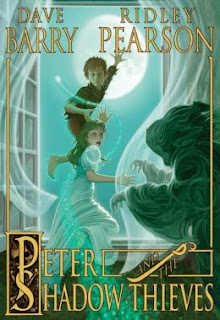
I came home from Peter and the Starcatcher, the play, so wanting to spend more time with the characters that I cracked open Peter and the Shadow Thieves, the second in the Barry/Pearson series, and then went on number three, Peter and the Secret of Rundoon. And thus I remembered why I almost didn't give the play a chance.
First off, I freely admit to being put off by the complete departure from canon, from the character of Peter to the reason why Neverland exists. I have to accept here that one of my personal peeves is the reduction of the wondrous to something easily explained by a prosaic element. Starstuff is not prosaic in itself, but it's the single cause of literally all life in the universe and the reason for the cosmic battle between good and evil, life and the void. (How the diabolical Lord Ombra can be an ambassador for the void, yet exist, is not explained.)
Starstuff is the reason as well for why Peter doesn't age and can fly, the presence of mermaids (who began as fish exposed to starstuff--an explanation which the play turns into an Edwardian music hall number to great success), the menace of the crocodile, even Tinker Bell--a bird shaken up with starstuff to create a fairy. So there are no other fairies, no actual magic on the island, no ability to fly that doesn't come without assistance from--for all intents and purposes--aliens. A trope that is another pet peeve of mine. And Peter is not merely a boy who refuses to grow up, but a boy from a Very Important Family with a Purpose.
Starcatchers the play takes such elements and magnified them to a silliness that nearly redeems them--the tribal chief was held captive in English kitchens, and sprinkles his phrases with cooking terms, thus making him drolly individual. Nods to the pantomime and vaudeville traditions tie the play in with decades of theatrical performances of Peter Pan. And references throughout to the source material, British history, and current events--often from the mouth of Black 'Stache--make it feel like part of the tradition. I don't feel this way about the books, which seem barely connected to the original source at all. Dave Barry admits to not having been a real Peter Pan fan growing up, and I suppose we see here the result of taking on a beloved classic without the heart attachment to it than others have.
Writing advice frequently encourages writers to keep upping the stakes, upping the stakes. Starcatchers the book series shows the danger in that, when the stakes become so universal as to rob them of any personal resonance. The stakes in the series become so abstract that the mythic quality of Barrie's story is lost. Peter Pan is a mythic presence because he expresses personal truths--the desire to stay young, the sacrifices involved in doing so, the nature of loss and forgetfulness. Another battle between the forces of good and evil in the universe simply does not resonate with me in the same way. I've read that/heard it/seen it so many times now, it's simply another flavor of something that has nothing to do with my own experience. Yes, the annihilation of the universe is a frightening thought. So is the annihilation and loss of many other things that I am more likely to experience for myself.
More specifically, there are aspects of Pearson/Barry's Starcatchers that would bother me in any context. Characters who are not well-educated and well-bred are fair game for mockery, such as the pirates. The evil land of Rundoon is set in a desert, where the people wear robes and turbans and ride camels--can we tell it the book was written post 9/11? (Published in 2007, to be precise). The problematic Indians of the original story are transformed into nearly-as-problematic Pacific islanders called the Mollusk Tribe, led by Fighting Prawn--not exactly dignified. While Pearson/Barry occasionally seem to realize the consequences of colonialism, the play actually calls attention to them with jokes, and don't approach the story from the books' viewpoint of aristocratic natural leaders, which among other things, leaves any number of interesting stories untold and viewpoints unexpressed.
I like the character of Molly, but I find little in these books as a whole to identify with, and I'm sure there are young adults reading these books who feel the same way. It's the authors' choice to approach their subject this way, of course, but it does seem to me that it adds to a large collection of the same, rather than breaking the new ground they surely intended. And while the books are lauded for their imagination, I find too much I've seen before. Molly and Teacher the mermaid are both unusually beautiful. (I miss Hermione Granger.) Tubby Ted is obsessed with food. Battle between good and evil. Right. Got it.
Examining my responses to the books as opposed to the play has been interesting, and you can look forward to more on this. (Sorry. No, wait, I'm not.) Specifically, I've had to analyze what types of fairy tale retelling I like and which I don't, and why. And then there's the Starcatchers books' treatment of Captain Hook, which merits its own post. (That you probably knew to expect.)

I came home from Peter and the Starcatcher, the play, so wanting to spend more time with the characters that I cracked open Peter and the Shadow Thieves, the second in the Barry/Pearson series, and then went on number three, Peter and the Secret of Rundoon. And thus I remembered why I almost didn't give the play a chance.
First off, I freely admit to being put off by the complete departure from canon, from the character of Peter to the reason why Neverland exists. I have to accept here that one of my personal peeves is the reduction of the wondrous to something easily explained by a prosaic element. Starstuff is not prosaic in itself, but it's the single cause of literally all life in the universe and the reason for the cosmic battle between good and evil, life and the void. (How the diabolical Lord Ombra can be an ambassador for the void, yet exist, is not explained.)
Starstuff is the reason as well for why Peter doesn't age and can fly, the presence of mermaids (who began as fish exposed to starstuff--an explanation which the play turns into an Edwardian music hall number to great success), the menace of the crocodile, even Tinker Bell--a bird shaken up with starstuff to create a fairy. So there are no other fairies, no actual magic on the island, no ability to fly that doesn't come without assistance from--for all intents and purposes--aliens. A trope that is another pet peeve of mine. And Peter is not merely a boy who refuses to grow up, but a boy from a Very Important Family with a Purpose.
 |
| The play, doing it right. |
Starcatchers the play takes such elements and magnified them to a silliness that nearly redeems them--the tribal chief was held captive in English kitchens, and sprinkles his phrases with cooking terms, thus making him drolly individual. Nods to the pantomime and vaudeville traditions tie the play in with decades of theatrical performances of Peter Pan. And references throughout to the source material, British history, and current events--often from the mouth of Black 'Stache--make it feel like part of the tradition. I don't feel this way about the books, which seem barely connected to the original source at all. Dave Barry admits to not having been a real Peter Pan fan growing up, and I suppose we see here the result of taking on a beloved classic without the heart attachment to it than others have.

Writing advice frequently encourages writers to keep upping the stakes, upping the stakes. Starcatchers the book series shows the danger in that, when the stakes become so universal as to rob them of any personal resonance. The stakes in the series become so abstract that the mythic quality of Barrie's story is lost. Peter Pan is a mythic presence because he expresses personal truths--the desire to stay young, the sacrifices involved in doing so, the nature of loss and forgetfulness. Another battle between the forces of good and evil in the universe simply does not resonate with me in the same way. I've read that/heard it/seen it so many times now, it's simply another flavor of something that has nothing to do with my own experience. Yes, the annihilation of the universe is a frightening thought. So is the annihilation and loss of many other things that I am more likely to experience for myself.
More specifically, there are aspects of Pearson/Barry's Starcatchers that would bother me in any context. Characters who are not well-educated and well-bred are fair game for mockery, such as the pirates. The evil land of Rundoon is set in a desert, where the people wear robes and turbans and ride camels--can we tell it the book was written post 9/11? (Published in 2007, to be precise). The problematic Indians of the original story are transformed into nearly-as-problematic Pacific islanders called the Mollusk Tribe, led by Fighting Prawn--not exactly dignified. While Pearson/Barry occasionally seem to realize the consequences of colonialism, the play actually calls attention to them with jokes, and don't approach the story from the books' viewpoint of aristocratic natural leaders, which among other things, leaves any number of interesting stories untold and viewpoints unexpressed.
 |
| Lovely art by Greg Call, as always, but why has Molly become inexplicably blonde? |
I like the character of Molly, but I find little in these books as a whole to identify with, and I'm sure there are young adults reading these books who feel the same way. It's the authors' choice to approach their subject this way, of course, but it does seem to me that it adds to a large collection of the same, rather than breaking the new ground they surely intended. And while the books are lauded for their imagination, I find too much I've seen before. Molly and Teacher the mermaid are both unusually beautiful. (I miss Hermione Granger.) Tubby Ted is obsessed with food. Battle between good and evil. Right. Got it.
Examining my responses to the books as opposed to the play has been interesting, and you can look forward to more on this. (Sorry. No, wait, I'm not.) Specifically, I've had to analyze what types of fairy tale retelling I like and which I don't, and why. And then there's the Starcatchers books' treatment of Captain Hook, which merits its own post. (That you probably knew to expect.)


