navigation

Thursday, February 13, 2014

Sports and letters


Not only did Mr. Barrie write his friends into Peter Pan as pirates who met terrible ends, he coerced them into playing on a cricket team whose ineptitude provided thirteen years of jokes.

A.E.W. Mason and Maurice Hewlitt (father of Cecco) were members of the Allahakbarries, a team formed in 1887 with a name born not only of a horrible pun but of a misapprehension ("Allah akbar" meaning "God is great," rather than "Heaven help us.") Among the players were A. A. Milne, Arthur Conan Doyle, P.G. Wodehouse, Alfred Lord Tennyson's son Charles, and George Llewelyn Davies, one of the group of boys whose make-believe games with Barrie inspired the creation of Peter. H.G. Wells and G.K. Chesterton were also invited, but declined to join.


Allahakbarries in 1913,
with J.M. Barrie, middle row, third from left

Barrie was not a skilled cricketeer, nor were most of his team members. Luckily, Conan Doyle had some notable sporting expertise, and from time to time players with greater ability were recruited

A slender volume entitled Allahakbarries C. C. was privately published by Barrie in 1890 and a revised edition in 1899. This latter was dedicated to "To Our Dear Enemy Mary de Navarro," a well-known American stage actress who formed a cricket team from Broadway artists and bowled out Barrie--evidently with great success--during a match in 1897.

Thursday, February 6, 2014

Friends in unexpected places

It's common enough for authors to write their friends and enemies into their works--Edgar Allan Poe wrote horrible fates for his critics, in one notable case--but I find it difficult to do so myself. I feel as if I can't do justice to my friends, and the sight of an enemy's name in my manuscript turns my stomach. (Which is not to say they never appear, merely that I don't make it obvious.)

But James Matthew Barrie had no such qualms about writing his friends quite blatantly into the pirate crew in Peter Pan. 
Given that he shares his given name with the pirate captain, I suppose it should have come as less of a surprise.


The Voyages of Captain Scott by Charles Turley, foreward by J.M. Barrie

I made this discovery while I was writing at my office (aka Wayward Coffeehouse), when I chose to double-check the spelling of pirate Charles Turley's last name online rather than go back home for the book. And I cringed to discover that the aforementioned Mr.Turley, one of my least favorite members of the crew as I'm writing it, was a good friend of Barrie's. And now that I've gotten used to seeing him that way, I can't change it. 

In a copy of "St. Nicholas: A Monthly Magazine for Boys and Girls, Volume 34, Part 1," I found this:

James M. Barrie, author of a number of things besides "Peter Pan," recommends highly the work of Charles Turley, whom he calls "the Trollope of boyhood." The name of the most recent of Mr. Turley's books is "Maitland Major and Minor." "The boys described in the book," says Mr. Barrie, "are the real thing; they run daily into it and out of it, never sitting down to be photographed."


Scourie Lodge

Poor George Scourie, another of the Jolly Roger's crew, is, er, not in my book for long. His name is a composite drawn from Scourie Lodge in northwest Scotland, and the innkeeper's son, George Ross, who was a friend of Nicholas Llewellyn Davies--the youngest of the boys with whom Barrie created the games that were the inspiration for Peter Pan. 


At least in The Stowaway, Mr. Cecco (first name Raffaello, with a rolled "r'),  is an experienced, handsome, and clever crew member, exemplary to the point of irritating.This might seem odd to Maurice Hewlett, a novelist friend of Barrie and father of the original Cecco. There is also a reference to "Cecco Hewlett's tree" in The Little White Bird, the book in which Peter Pan first appears.


Alfred Edward Woodley Mason

The real Alf Mason was a  politician and a captain in the Manchester Regiment of the British army. He was also the author of about thirty novels, and will be best known to modern readers as author of "The Four Feathers," which was made into a 2002 film starring Heath Ledger and Kate Hudson. I saw it upon its release, little knowing it would turn out to be one of the Barrie coincidences that continually circle around me

 In The Stowaway, Mr. Mason is one of Vivian Drew's closest friends among the crew, and not only because they share a geographic background. For some reason, tellers of Peter Pan besides me have also settled on Mr. Mason as one of the less reprehensible of the crew--see Peter and the Starcatchers, where he's not even a pirate. Perhaps it's the name--he simply sounds decent.


Thursday, January 30, 2014

Peter pops up, part two

When I say more recent pop-up books include bells and whistles, I mean actual bells. The jacket copy on this version, with art by Paul Hess, says "with sound," and it does not lie. Big Ben starts chiming when you open the book, and each sound runs as long as it's programmed, even if you close the covers. This can be unsettling.


Seagulls, water, and pirate laughter, if you're wondering. I think it's the most evocative theme in the book, but I hear kids like Big Ben the best.


Robert Sabuda's version taught me to buy pop-up books new whenever possible. I might figure out some sort of art project to do with the worn-out book containing illustrations which, sadly, no longer pop up.


Note how cleverly I have propped the book open for photographing with the deck for a card game called, appropriately enough, Stowaway. (Weirdly enough, too, given that I found it at a comic store as I was buying the Hook issue of the Grimm's Fairy Tales Presents: Neverland comics.)


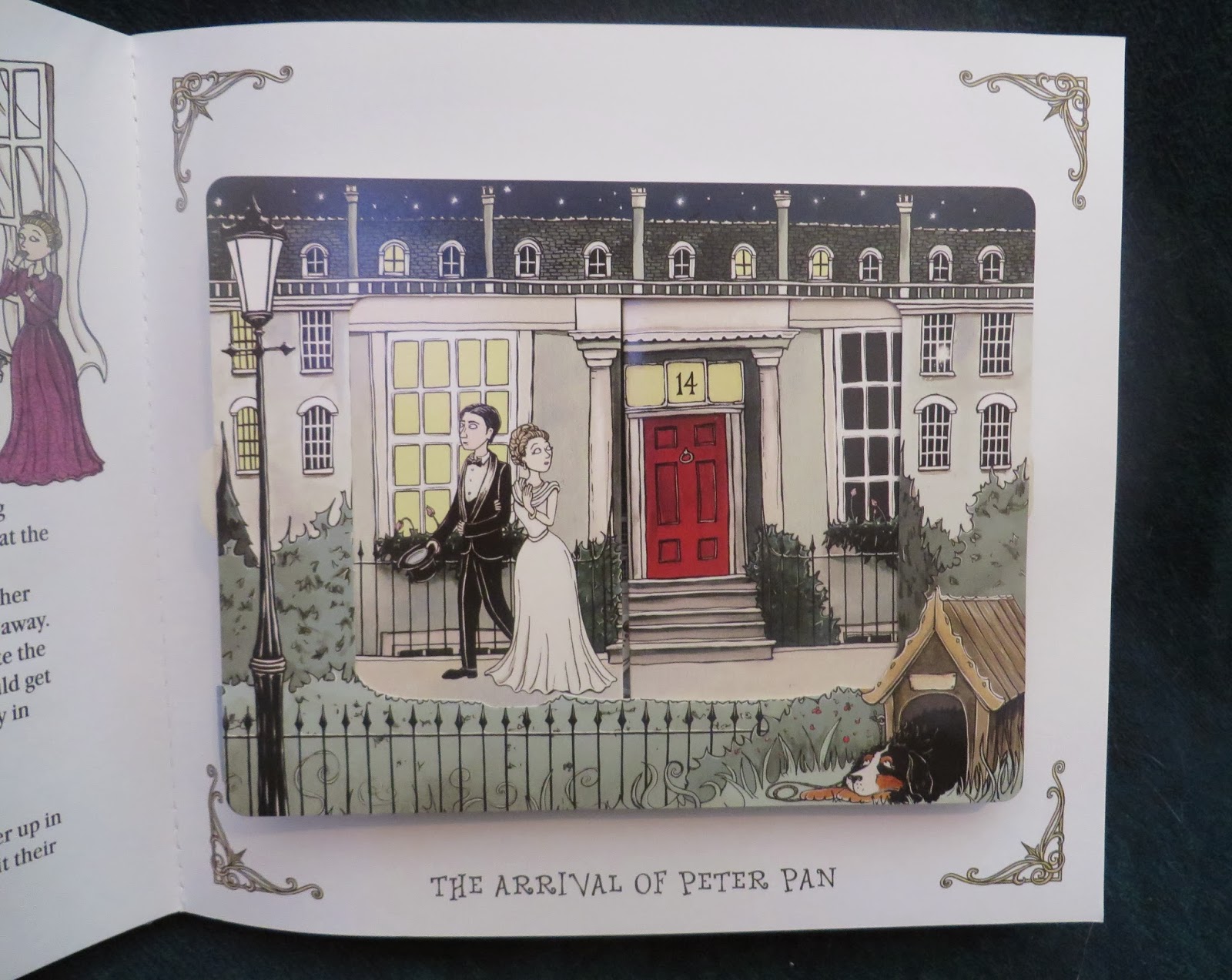
I am unable to ignore that sometimes art quality takes backstage to the novelty of three-dimensional presentation. Visit Part One of this topic for evidence.But such is not the case with Nicola Robinson's Peter Pan. It was released just last year, so finding a new copy isn't a challenge.


Each art spread has a tab on each side that opens out, like so...


...to take you quite literally into the center of the charming Gorey-esque drawings. Not only am  I very happy with this addition to my collection, I absolutely recommend visiting Robinson's site to see more of her work.

Friday, January 24, 2014

Peter pops up, part one

A post in two parts, to spare your browser. (With apologies that my photography gives only an idea of the craftmanship. These were even harder to capture than I'd expected.)

A story with flying children and pirate ships does lend itself to the pop-up book technique, but I had no idea how easily I'd find seven versions of Peter Pan "transformational" books. None of them are from longer ago than the early 90s, but surely older ones exist. Possibly even some which still work, although lowered expectations are probably the healthy approach.


While three-dimensional art books have been around since the 1200s, says Wikipedia, the oldest Peter Pan pop--up I have is from 1991, with art by Carolyn Geer. The folded card-stock in these books takes up so much space, the stories they illustrate end up necessarily truncated. This version chose to address the issue by publishing the story in four volumes. No, I did not find them all from the same seller. Yes, I have the completist collector disease.


This  "Change the Picture and Lift the Flap" book from 1992, illustrations by Edmund Caswell, taught me it was time to pay more attention to those little descriptions of used book quality. This goes beyond aesthetic issues like cover stains and names written inside--you may end up with a book with only one functioning construction. Most of these are out of print, they frequently received a lot of use from small children...you see the problem. 


The reader pulls the tab on the lower left of the circle (gently!)


and turns the image


into a different one. Fun effect, when it works.


I lucked upon a Chinese pop-up Peter from 1996, but sadly I cannot tell you any more about it than that. It is lovely, though.


After this, there's a gap in my collection of about ten years, after which pop-up books become elaborate and pull out some new tricks. More on those in part two. 

Thursday, January 16, 2014

Blue fruit

As requested--no, really--a short vignette that didn't make the cut for The Stowaway, but which manages nevertheless to work in several themes of the book. We begin with Captain Jas. Hook speaking to Vivian Drew.

"We need to replace the oranges those wretched boys stole. Care to accompany me to the island?"

It couldn't be much more dangerous than the ship had been recently, I thought, and agreed, provided we could stay within hailing distance of the Jolly Roger. So after a brief stop at the cabin for hats (the lesson had finally taken), we took possession of the dory.

"We're rowing ourselves?" I had never thought to see James take this duty on.

"We can hardly do a worse job than some of our compatriots," he said, a point I could not argue.


This is Koh Samui, Thailand, not Never Neverland, but the resemblance is notable.

The sea was calm and the afternoon windless. We left the dory in a small cove and set off along the powdery sand of the beach, picking our way carefully through a crowd of tiny spotted birds intent on dining from shells and strands of rotting seaweed. 

"Look up, Viv. Mr. Smee says they're delicious." I followed his gaze to the feathery leaves of a pale-barked tree and a cluster of fruits tucked within, something like plums but with skins of turquoise blue.

I shaded my eyes with my hand and frowned. "Pretty enough, but we shouldn't eat them."

"They didn't hurt Mr. Smee, Viv, and they won't hurt us."

Didn't your mother ever warn you about blue food?”

“It's a wonder my mother didn't encourage me to eat it.”

I shook my head, but squeezed his forearm to acknowledge the real mistrust that lay beneath his words. Probably my own parents wouldn't have even noticed if Miles and I had poisoned ourselves on blue food, as long as we'd ultimately survived.

“You don't eat blueberries?” James asked.

They're more purple than blue," I pointed out.

He waved aside my further protests, plucked one of the fruits, and sliced it open with his deck knife. The flesh inside was as blue as the rind, and crunched like an apple as he chewed. Curiosity won out over caution as he presented to me another slice upon the point of his hook, and I bit into it with only a moment of hesitation. 

“It tastes somewhere between an orange and a lemon,” I said in surprise.

“I wonder if these would be any protection against scurvy. Probably best not to chance it.”

“Probably best to see if we survive the remainder of the day after eating them,” I said. “Assuming we don't die at the hands of the lost boys or the teeth of the crocodile.”

Neverland, according to the 2003 film adaptation of Peter Pan

I have made you dismal, haven't I?”

I thought for a moment. “No, not much more so than I have always been.”

“We are distressingly well-suited for each other, then."

“Agreed.” I took another bite of the blue fruit.

“There are worse ways to die than this,” he said.

“If a person is looking for one.” I wiped my hand on my skirt and sat down carefully in the coarse grass at the base of the tree, leaning against the trunk and closing my eyes.  “Take the first watch, will you, sir?”

“As the lady commands,” he said, but belied his words when he reclined beside me and rested his head in my lap.

“Hmph,” I said sternly. But I was already stroking his hair, and I doubt anyone of our acquaintance would have believed I truly objected.


Thursday, January 9, 2014

Peter and the panto tradition

As an American, my knowledge of the English pantomime tradition has been minimal and not first-hand until recently. And true to form, I became curious about it after learning about actors like Henry Winkler and David Hasselhoff playing Captain Hook in Christmas panto interpretations of Barrie's play.

Henry Winkler as the Captain

I was lucky enough to discover Seattle's own Fremont Players doing a panto of Dick Whittington and His Cat over the holidays, so I can now write this from the point of view of the initiated. I can understand why this is a popular holiday activity after taking part in the fun myself.


Pantomime has a strong foundation, arising from the tradition of commedia del'arte, which traveled from Italy to England in the 1600s. When Charles Dickens connected panto and Christmas in his writings, it became an expected part of the holidays for children in England and now beyond. Panto performances are traditionally loose versions of folk or fairy tales, with stock characters and scenes, contemporary references, and humor for all ages in the form of slapstick and double entendres. Popular actors from stage, film, and TV are a particular draw in larger theater productions, and have been since the late 1800s.

While panto becomes increasingly popular in the US, with a recent feature on CNN explaining it to the American audience, British critics debate its demise. Not all theater critics agree that this is imminent, or even close to occurring.

I couldn't find the premiere date of the first Peter Pan panto (I am not going to try to say that five times fast), but the only adaptation allowed by copyright until recently was the 1953 Disney film, so panto versions of it are fairly new. J.M. Barrie's original play doesn't incorporate many panto elements, although it does include audience participation (clapping to bring Tinker Bell back to life), and actors dressed as animals (Nana and the crocodile). Peter was originally played by a woman not because of a cross-dressing tradition, but because children weren't allowed to work in the theater past 10 pm. Nor does the original play include a cross-dressing Dame, naughty humor, singalong, slapstick,or a chorus. But all these have been easily added, even the Dame as a human nurse (as opposed to Nana the dog) or a female pirate.

Mermaids of the alarming variety

Broadway production Peter and the Starcatcher includes many panto elements--slapstick, a chorus, the cross-dressing Mrs. Bumbrake, double entendres and pop culture references, cultural satire--thereby tying the production to both Barrie's play and the panto tradition. (Starcatcher and Dick Whittington also both included a boat, a ship wreck, and a desert island--none of which I knew to expect in the latter, although I realize how unlikely that sounds in retrospect.)

The Fremont Players did a panto Peter Pan in 2011, but I"m glad I didn't discover them till Dick Whittington. I had no objection to shouting insults at the odious King Rat. But while I love a campy Captain Hook, I recoil at the thought of booing and hissing the poor man, or suffering the popcorn hurled in my direction if I cheer instead.

Wednesday, January 1, 2014

Revelations in word clouds

This little cloud of letters is called a wordle, and it comprises the most commonly used words in this blog. ("Paste link into your blog" did nothing of the sort, so you get a scan here, plus the link above if you want to try your own.)


 I suppose I can live with BOOK as my most prominent word. As I ran this, I had a fear that a giant PETER would appear in the middle, causing me to rethink my entire policy of even-handed journalism. But at least CAPTAIN is nearly as large, and HOOK makes a decent-sized appearance too--next to TIME, an unintentionally appropriate connection. I think the entirety of the cloud does point to what I'm hoping to accomplish both here and in The Stowaway--especially with the large RESPECT in the center--which is encouraging.

Still, it's obvious what my blog's New Year's Resolution needs to be.


No, wait, that's not quite what I meant.


More Captain Hook in this blog in 2014. Think I can manage that?